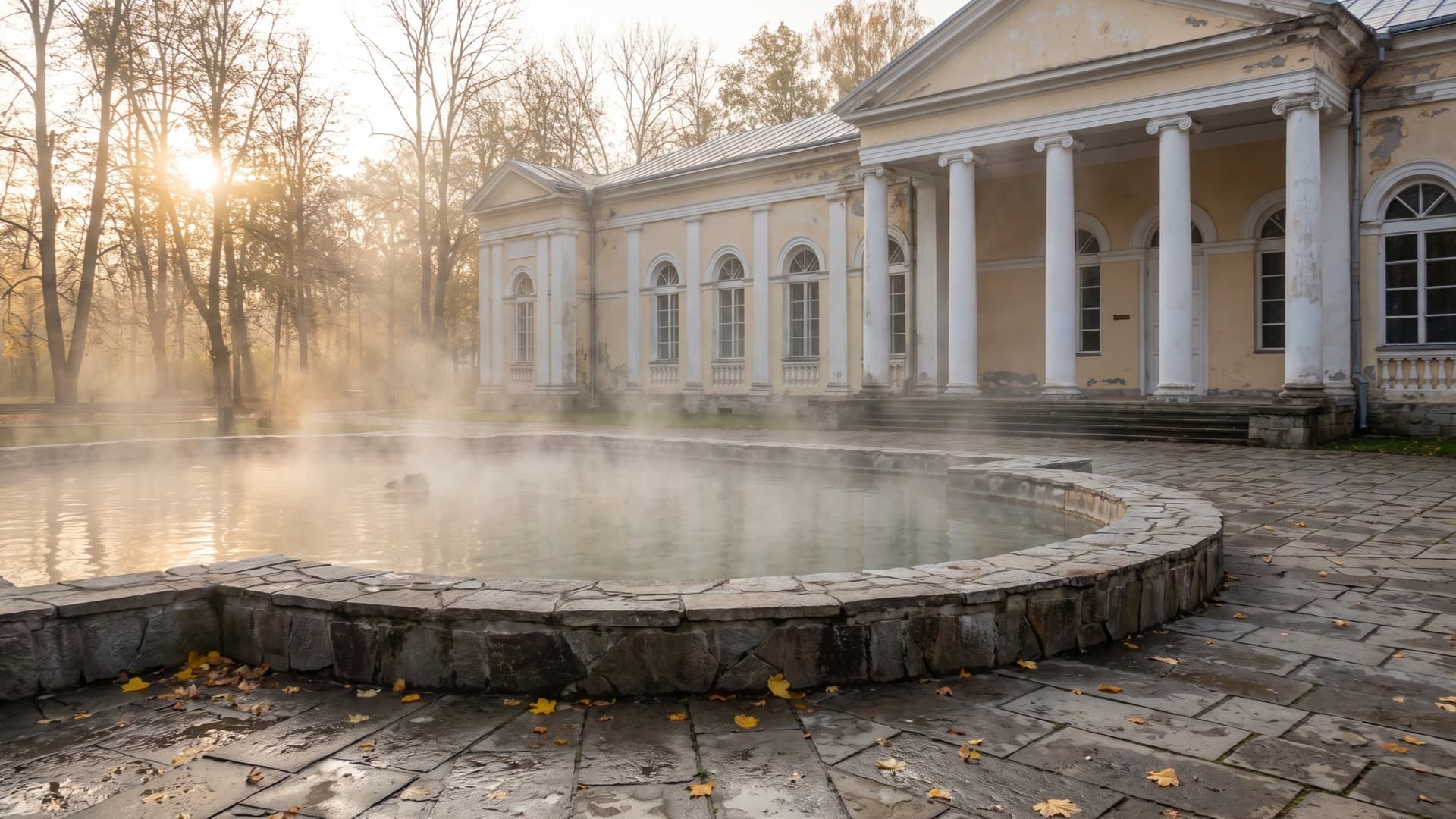
Einhard, who knew Charlemagne and wrote his life, says the emperor loved the vapour of natural warm springs and swam so well that nobody could beat him. That, Einhard writes, is why he built his palace at Aachen and spent his last years there. He did not bathe alone. He invited his sons, his nobles and his friends, and sometimes his retinue and bodyguard as well, so that a hundred people or more might be in the water with him.
The water is still there. The Romans had used it first: in the first century the Sixth Legion channelled Aachen's hot springs into a spa, and the town grew around it. The city now counts fifteen accessible springs, six of them active, that come out at between about 38 and more than 70 °C. One of them, the Rosenquelle on Komphausbadstraße, fills the pools of Carolus Thermen, the city says. You can swim, a few streets from the cathedral where Charlemagne is buried, in water from the ground he chose his capital for.
That is the German pattern. Bathing here is old, and over the centuries it has collected an unusual amount of law, medicine and etiquette. There are 134 thermal baths in Germany on the list under this article, from Aachen in the far west to the brine pools of Brandenburg, and the two southern states hold most of them: 31 in Baden-Württemberg, 29 in Bavaria.
What does "Bad" in a German town name mean?
It is a protected title. In Germany only a state-recognised Heilbad, a health spa, may put Bad in front of its name. Recognition is an administrative act by the federal state, not by Berlin, and each state writes its own rules. The common ground is a natural remedy that comes out of the ground and has proven itself in use (a mineral or thermal spring, a medicinal mud, a healing gas), the facilities to apply it, a climate that is checked regularly and medical staff in town.
The title has a history of its own. Kissingen became Bad Kissingen in 1883, by grant of King Ludwig II of Bavaria. Füssing, in Lower Bavaria, waited until 1969. A town that loses its recognition may sometimes keep the word, on the practical ground that repainting every sign would cost more than it was worth.
Thermal water has a definition too. In Germany groundwater counts as thermal when it is warmer than 20 °C where it emerges, a lower bar than in Hungary. The word Therme on a building, by contrast, is not protected at all, and what Therme means explains why it can sit over heated mains water as easily as over a spring.
Is Heilwasser a medicine in Germany?
Legally, yes. German law treats Heilwasser, healing water, as a medicinal product under the Arzneimittelgesetz, the Medicines Act, and not as a food the way ordinary mineral water is. A bottle of Heilwasser on a supermarket shelf needs an official marketing authorisation, like a tablet.
The bath is the exception. Section 21(2) of the same act exempts Heilwasser that is not prepared in advance or packaged for sale, and water used on site externally or by inhalation. So the pool itself is not licensed like a drug. A bath that calls its water Heilwasser is pointing to its spring and its analysis. 54 of the 134 German thermal baths, 40%, are recorded as using certified medicinal water, which is a floor: a bath that says nothing about its water is simply not counted. How the certificate compares across borders is in certified medicinal water, and the difference between thermal, mineral and medicinal on a sign is in this guide to the three words.
Bad Ems, on the Lahn near Koblenz, shows what that analysis looks like in practice. The operator of Emser Therme, which stands right on the river, gives the Robert-Kampe-Sprudel at 56.6 °C where it leaves the ground, with more than thirty minerals and trace elements. Hydrogencarbonate is the largest share, and sodium and chloride give the water its character. The same water is gently evaporated to make Emser salt, pressed into pastilles or inhaled on site. The operator recommends it for conditions from the airways to the joints and suggests about twenty minutes in the water followed by twenty to thirty minutes of rest. Those are the operator's statements, not ours.
Three towns on the World Heritage list
Bad Ems is one of three German towns in the Great Spa Towns of Europe, inscribed as a UNESCO World Heritage Site in July 2021. The other two are Baden-Baden and Bad Kissingen. Their partners include Karlovy Vary and its neighbours, described in the Czech spa towns.
In the nineteenth century these were the places Europe's courts went in summer. Kaiser Wilhelm I came to Ems, and so did Richard Wagner and Fyodor Dostoevsky; Jacques Offenbach premiered operettas at the Kurtheater. The town gave its name to the Ems Dispatch of 1870, the telegram that set off the Franco-Prussian War. Bad Kissingen had Empress Elisabeth of Austria, Tsar Alexander II and Ludwig II among its guests, and Otto von Bismarck came many times. In 1874 he survived an assassination attempt there by Eduard Kullmann, at the height of the Kulturkampf. Of Kissingen's seven springs only the Schönborn spring is warm; the town's modern bath, KissSalis Therme, opened in February 2004.
What is a visit to one of the historic baths like?
Slower than you expect, and with fewer clothes.
Baden-Baden's springs come up on the slopes of the Florentinerberg: twelve artesian springs carrying sodium chloride, rising from 1,200 to 1,800 metres and reaching the surface at 56 to 68.8 °C. The emperor Caracalla is credited with enlarging the Roman baths here around 200 AD, and the modern Caracalla Therme, built from 1983 to 1985, draws on the same supply. Next door stands Friedrichsbad, and its origin is a small piece of political history. When a law of the North German Confederation banned gambling in 1868, Baden-Baden's casino income was in danger, and the town built a bath instead. The architect Karl Dernfeld studied the famous baths of the day with the spa doctor Carl Frech, and the Renaissance-style palace opened in December 1877. The operator says it was then thought the most modern bath house in Europe. The warm rooms are lined with hand-painted majolica tiles.
The bath is a sequence, not a pool. The operator lists seventeen steps. You start with a thermal shower, then about fifteen minutes in warm air at 54 °C and five in hot air at 68 °C. After another shower comes an optional soap-and-brush massage, then two thermal steam rooms at 45 and 48 °C, a full bath at 36 °C, a bubbling bath at 34 °C, a circular pool at 28 °C, and a brief moment in a cold pool at 18 °C. Then come drying, cream, a relaxation room and finally a reading room. The operator suggests allowing about three hours. You bring nothing: towels and bath shoes are provided. On most days bathing is without swimwear, in the traditional way; Wednesday and Saturday are swimwear days, when swimwear is compulsory. The soap-brush massage can only be booked on the day, on site.
In Wiesbaden, the Kaiser-Friedrich-Therme was built from 1910 to 1913 to a design by the city's building inspector, August O. Pauly, in a style German Wikipedia places between reform architecture and Jugendstil, with mosaic tiles in its Irish-Roman bath. The operator calls it a homage to the Roman sweat bath on whose foundations it stands. It is fed by the Adlerquelle, at 64.6 °C the second-largest thermal spring in Wiesbaden after the Kochbrunnen. The house is textile-free except on Thursdays, its textile day, and nobody under 16 is admitted.
In the Black Forest, Palais Thermal in Bad Wildbad began as the Graf-Eberhard-Bad, built from 1839 to 1847 to plans by Nikolaus Friedrich von Thouret. Its first pools were cut into the natural rock and covered with sand, and the spring water flowed in by its own artesian pressure to about half a metre deep. Between 1896 and 1901 the open courtyard became a hall in the Moorish style, and in 1995 the bath reopened under its present name, restored to its look of the 1920s. Today the sauna area is textile-free and undressing there is compulsory; in the bathing area swimwear is your choice except on the textile day. Children are admitted from 12, with an adult.
These are the strict end of a general rule. In the German-speaking tradition the sauna is undressed and the swimming pool is not, and first-time visitors are caught out at exactly that door. Textile-free bathing sets out the etiquette, and sauna types explains the words on the doors, from the Finnish sauna to the Aufguss, when water is poured on the stones.
Hot spring or brine: which should you choose?
Germany's water comes roughly in two kinds, and the map divides them.
In the south and west the water is often hot. 10 German thermal baths publish a source temperature of 50 °C or more, Baden-Baden and Bad Ems among them. Bad Füssing, in the Lower Bavarian spa triangle, came out of an accident. In 1938 a rig drilling for oil hit water instead: sulphurous, 56 °C, from about a kilometre down. The first spa opened in 1950, and today the town has three public thermal baths, Europa Therme, Therme eins and Johannesbad Therme. Why that water smells of eggs, and what it does to silver, is in sulphur thermal water. The baths around Munich, from Erding to the Chiemgau, have their own guide, thermal baths near Munich.
Further north and east the water is more often salt than hot. Past a certain strength it is called Sole, brine: a solution of at least 14 g of dissolved salts per kilogram of water, and in medical use one of 1.5 to 6 per cent salt. Salt water is denser than fresh, so you float higher in it, and a strong brine pool is the place to lie back rather than swim lengths.
Brine baths are precise about their numbers. Obermain Therme in Bad Staffelstein, in Upper Franconia, calls its water Bavaria's warmest and strongest thermal brine, with more than 114 grams of dissolved minerals per litre at the source. That is far too strong to bathe in, so the operator dilutes it with water from 200 metres down, to 3.5 per cent in the bathing pools and 1.5 per cent in the exercise pool. NaturTherme Templin, in the lakes of the Uckermark north of Berlin, draws its thermal brine from 1,650 metres and uses it at 1 to 6 per cent depending on the pool. Jod-Sole Therme Bad Bevensen, in the Lüneburg Heath, uses an iodine brine from the town's own source. There is more in brine baths in Europe.
So the choice is less about which water is better than about what you want from the afternoon. A hot spring is for soaking, a strong brine for floating, and the operator's pool list tells you which water is in which basin.
Before you go
Read the rules on the operator's page at home: the swimwear days at Friedrichsbad and in Wiesbaden, the age limits if you travel with teenagers, how a treatment like the Baden-Baden brush massage is booked. If you have a heart or circulation condition, are pregnant or are unsure how long to stay in hot water, ask your doctor; what a bath says its water is good for is the operator's statement, not medical advice.
The list under this article holds all 134 German thermal baths, from Carolus Thermen on Charlemagne's springs to the brine pools of the Uckermark. If you want the old rituals, start in Baden-Baden or Wiesbaden; if you want to float, look north.