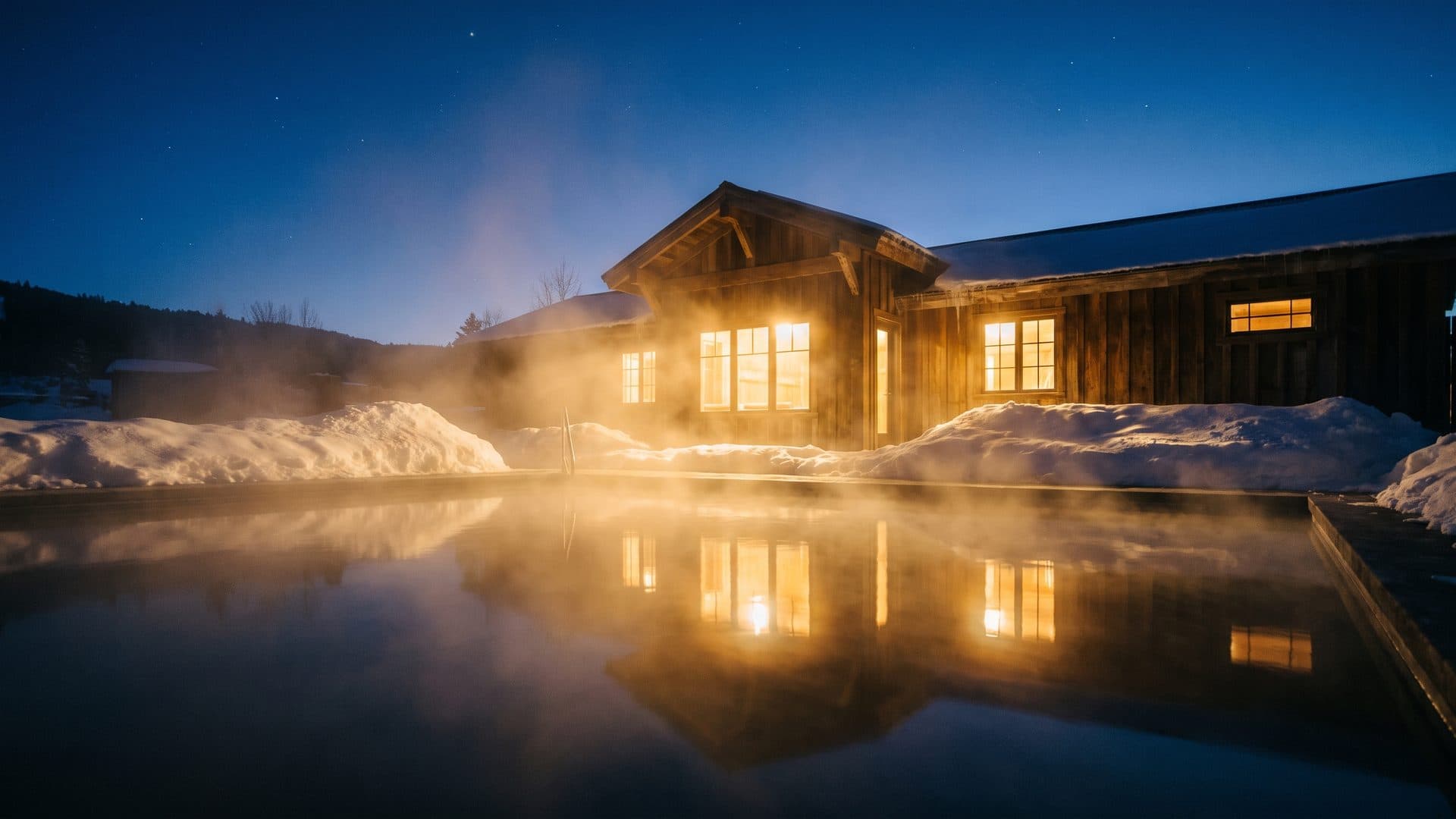
In 1891 people in Flúðir, in the south of Iceland, built a pool at Hverahólmi, a patch of ground where hot water comes up by itself. The operator of Gamla Laugin — "the old pool", sold to visitors as the Secret Lagoon — calls it the oldest swimming pool in Iceland. The local council met there until 1894. In 1909 the first swimming lessons in the country were held in it, and they ran every year until 1947, after which the pool fell into neglect. It reopened in June 2014.
The water still arrives the old way. The springs around the pool, Vaðmálahver and Básahver among them, feed it continuously, and the operator says the whole volume is replaced in about a day. One of them, Litli Geysir, spouts every few minutes. A path runs around the pool so you can watch the springs without stepping into them, and the pool itself stays at 38–40 °C all year. In January that number is the whole story.
Bathing outdoors in winter is the photograph that sells thermal baths, and it is a real thing at fewer places than the photographs suggest. 126 baths state that their outdoor water stays open all year. Many more probably do and simply never say so, which is the one reason to treat that number as a starting point rather than a census. What follows is about the places that do say so, and what an afternoon there is actually like.
Why does a warm pool feel so different in winter?
Part of it is plain physics. Warm water in cold air steams, so the surface of an outdoor pool in December is a moving layer of mist. Your body is in water at roughly skin temperature while your face is in air well below freezing. The contrast is the experience. In summer the same pool is pleasant; in winter it is an event.
The national parks service of New South Wales describes it well at Yarrangobilly Caves Thermal Pool, in Kosciuszko National Park in the Snowy Mountains: you float while mist rises off the water and snow covers the ground around you. The pool is fed by a natural spring that keeps it at 27 °C all year, it is about 20 metres long and two and a half deep, and its water spills over a low edge into a wading pool for children. The park service mentions water dragons and platypus in the pool and the river beside it. Getting there is the part people forget: it is a short but steep walk down a sealed road, and the park rates it as hard. The change rooms are up at the picnic area, so the walk back in wet hair is part of the deal.
At Hanmer Springs, in the South Island of New Zealand, the setting is the attraction. The town averages 116 frosty nights a year, according to Wikipedia, and snow sometimes closes the road in. The first written account of the springs is a report in the Lyttelton Times in April 1859 by William Jones of St Leonard's station, who described seven round pools of water from warm to nearly boiling. A year later the Nelson provincial government set aside a reserve of more than a thousand hectares around them. In 1882 William Rolleston, the Minister of Lands, insisted that the public keep access, and building on a bath house began in January 1884. For a long time the pools were split by sex and swimming costumes were not allowed; the hexagonal pools came in 1978, the rock pools in 1992, the sulphur pools in 1999. Today the water leaves a borehole at about 52 °C and is cooled through heat exchangers to somewhere between 32 and 42 °C for the pools of Hanmer Springs Thermal Pools & Spa.
How warm does the water need to be?
Warmer than in summer, because in winter the problem is never the water. It is the part of you that sticks out of it, and the moment you stop moving. Of the 126 baths that say they are open outdoors all year, 69 publish a pool temperature, and 45 of those report 34 °C or more.
That threshold is a useful rule of thumb. Around 27 °C, as at Yarrangobilly, an outdoor pool in winter is for swimming: comfortable while you move, cold as soon as you hang on the edge. From about 34 °C up you can sit still, which is what most people picture. At Kúpalisko Oravice, in the north of Slovakia at the foot of the Western Tatras, the town of Tvrdošín gives its two uncovered pools as 34–38 °C, open all year and until late. The mountains you see from the water are the Roháče, and the town's page sells the place on exactly that: sitting in warm water outdoors in a cold climate, looking at the peaks.
Many baths publish a range rather than a single figure, and a range tells you more. It usually means a cooler pool for swimming and a hotter one for sitting, which in winter are two different afternoons. Read the pool list, not the headline number.
Two waters, one lake shore
Polynesian Spa in Rotorua sits on the edge of Lake Rotorua and draws on two springs that could hardly be more different. The Priest Spring is acidic and rich in sulphate. It is named after Father Mahoney, a Catholic priest who, the operator says, found relief from crippling arthritis bathing there in 1878; Māori had bathed in the same pool, Te Pupunitanga, for centuries before. The Rachel Spring is alkaline and rich in sodium silicate, and its water has been piped to the site since 1902. The operator states that the acidic water soothes tired muscles and the alkaline water is good for the skin, and those are its claims, not ours.
The guest list is long. The first bath house, the Pavilion, opened in 1882. In 1901 the Duchess of Cornwall and York came, and a bath was named after her. In 1902 Mary MacKillop, now Saint Mary of the Cross, came for treatment in that Duchess Bath and wrote in a letter, "I feel the baths are doing me good." The Ward Baths followed in 1931, named after the prime minister Sir Joseph Ward, and in 1972 the government leased them to a company that renamed them Polynesian Spa. The family pools run at 33–40 °C. One house rule surprises visitors with children: the Pavilion Pools, with five alkaline and three acidic hot pools, are for ages twelve and over.
Hot spring lagoon or Therme: which kind of place should you choose?
The places that keep outdoor water open in winter fall roughly into two families, and they are different days out.
The first is the spring in a landscape: Gamla Laugin, Yarrangobilly, Oravice, the lake-shore pools of Rotorua. The water is the reason the place exists, the setting does most of the work, and the facilities are often simple. At Gamla Laugin the showers are, in the operator's words, in traditional Icelandic style, separate for men and women. Swimsuits and towels can be rented. Book ahead in busy months: the operator says a spot is not guaranteed without a reservation.
Also in Iceland, Laugarvatn Fontana on the shore of Laugarvatn lake is built around steam rather than a pool: the operator invites you to bathe directly in steam from a natural geyser. It also bakes rye bread in the hot ground, and you can taste it while it is still warm. Icelanders, the operator notes, have used the same heat for bathing and baking for generations. The baths reopened after a complete renovation on 1 August 2026.
The second family is the designed Therme, a building with indoor and outdoor water and usually a sauna area, built to run in winter because winter is its season. 64 of the year-round outdoor baths have a sauna, and at the Therme end of the range it is part of the visit rather than an extra. If you are unsure what a Therme is, and why the word does not guarantee spring water, our piece on what Therme means goes into it; the vocabulary of the sauna area is in this guide to sauna types.
Panorama-Therme Beuren, below the escarpment of the Swabian Alb, is a good example of the type. It draws on two wells. The Wilhelmsquelle comes up from 755 metres at about 48 °C; the Friedrichsquelle, from 381.5 metres, is cooler. The operator places Beuren in the area of the "Swabian Volcano", active 16 to 11 million years ago, and then says, refreshingly, that there is probably no direct connection between the old volcanoes and the warm water. In winter the detail that matters is the swim lock: the outdoor Panoramabecken is joined to the big indoor pool by a channel, so you leave the building in the water rather than across a cold deck. Tuesday is women's day in one of the saunas.
Therme Meran, in South Tyrol, sits on the bank of the Passer across from the old Kurhaus. Merano became one of the spa towns of the Austro-Hungarian Empire in the nineteenth century, and Wikipedia credits Empress Elisabeth's visits with much of its popularity. The present building, opened in December 2005 and designed by the Bolzano-born architect Matteo Thun, is a cube of glass and steel in a park. Its water comes from the Vigiljoch near Lana, about eight kilometres away, where the operator says the mountain enriches rainwater with radon and fluoride. Meran is also the clearest lesson in reading the word "outdoor": according to the regional tourist board, the park with its eleven outdoor pools is open from mid-May to mid-September, while the operator's own winter photographs show an outdoor pool by the cube with snow on the mountains behind. Same bath, two winters.
What should you check before you go?
Three things, all on the operator's own pages, are worth the five minutes.
Which outdoor pools run this month. A bath that is open all year is not necessarily open outdoors in every basin all year. Meran is the example above; Beuren's large outdoor current pool runs warmer in winter than in summer, which tells you the operator plans for the season. Look at the pool list for the week you are going, not the summer photographs.
How you get from the changing room to the water. A swim-out channel, as at Beuren, is a different January from a walk across an open deck, and both are different again from Yarrangobilly's steep road. Wet hair freezes. A bathrobe and sandals make any walk shorter, and a hat keeps the steam from freezing in your hair.
Who may use which pool. Age limits like Rotorua's, adults-only sauna areas, women's days: they are posted, and they are easier to read at home than at the till.
Hot water outdoors in cold air is still hot water, and any guidance a bath posts about time in its hottest pools applies in January too. If you have a heart or circulation condition, are pregnant, or are unsure, ask your doctor before going; healing claims on a bath's website are the operator's statements, not medical advice. For the wider picture of bathing outside in any season, our guide to open-air bathing covers the summer side too.
The list under this article holds exactly the 126 baths that state their outdoor water is open all year, from Gamla Laugin and its geyser to the glass cube in Merano. Pick one, look up which pools run in the week you plan to go, and take a dry hat for the walk back.