In February 1983 Deutsche Texaco was drilling outside Erding, north-east of Munich, looking for oil and gas. On 12 February, at a depth of 2,350 metres, the bit hit water instead. It had a natural temperature of 65 °C. Building work began in November 1998, and on 3 October 1999 Therme Erding opened over the well, with a thermal hall and a sauna area where you bathe without a swimsuit.
That is how a lot of the warm water around Munich was found: by someone hoping for something else. Further south-east, at Bad Endorf near the Chiemsee, Wikipedia records that iodine-bearing medicinal water turned up by chance in an oil borehole in 1963, at 4,848 metres. The town became a recognised spa in 1987 and put "Bad" in front of its name a year later.
Not all of it is that new. The Romans were bathing in sulphur water on the Danube north of Munich by the early second century, and the salt springs of Bad Reichenhall, down by the Austrian border, were being worked about four and a half centuries before Christ. Within roughly a hundred kilometres of the city there are 14 thermal baths, 11 in Bavaria and 3 across the border in Austria. Between them they cover most of what a German Therme can be.
Where does the warm water near Munich come from?
From deep, mostly. The rock under southern Bavaria gets warmer the further down you go, and water that has spent thousands of years at depth arrives hot. The operator of the Altmühltherme in Treuchtlingen, on the northern edge of the circle, says its water is about 18,000 years old and comes up from 800 metres. It was found in 1981 by a mineral-water company drilling for something to bottle.
The temperature at the wellhead and the temperature in the pool are different numbers, and around Munich they often point in opposite directions. Erding's water arrives at 65 °C and has to be cooled before anyone can sit in it. Treuchtlingen's comes up at 28 °C, which is cool for a bath, and is warmed for the pools. A published well temperature tells you about the well, not about your afternoon.
The afternoon is usually cooler than the word Therme makes people expect. Of the 11 baths that publish a pool temperature, 3 reach 36 °C or more. Bad Wörishofen is a fair example: its main thermal pool is kept at 34 °C, and the 36 °C water is in the smaller health pools to one side. If you want to sit in hot water rather than swim in warm water, look at the pool list, not the headline.
Which baths near Munich are worth the drive?
It depends on the day you want. Here are six, from the biggest to the oldest.
Erding: the big one
Therme Erding calls itself the largest thermal spa in the world. According to Wikipedia the thermal area covers 27,500 square metres, two-thirds of it outdoors, under a glass dome 56 metres across that opens up to half its width in warm weather. There is a separate slide hall, a wave pool with some 300 palm trees growing under the glass, and a sauna world with around ninety Aufgüsse, the scented steam infusions, every day.
For a first visit the important thing is the layout, because the rules change as you move through it. The thermal halls and the slides are for swimsuits and families. The VitalTherme & Saunen is textile-free and, like the VitalOase wellness area you walk through to reach it, open only to guests aged 16 and over. The operator is explicit that textile-free does not mean naturist: between the showers and the turnstile you wear a swimsuit or a towel, outside the sauna area you put on a bathrobe, including in the restaurants, and phones and cameras are banned in the textile-free part altogether. If you would rather sweat in a swimsuit, the textile saunas are in the VitalOase. Towels and bathrobes can be hired at the entrance.
Bad Gögging: a Roman bath under a church
When the church of St. Andreas in Bad Gögging, near Neustadt an der Donau, was being rebuilt in the early 1960s, the builders found Roman masonry underneath. The excavation ran from 1960 to 1970 and uncovered a bath complex at least 56 by 30 metres, with a central pool 10.8 by 7.8 metres heated from below by a hypocaust. Wikipedia credits Emperor Trajan, around 110 AD, with having it built for the garrison of the nearby fort of Abusina. Brick stamps show it was paid for partly out of imperial money. A museum of Roman spa culture has shown the finds since 1980.
The water the Romans used was sulphurous, and it still is. In 1910 the sulphur spring was protected as a public healing spring, and in 1919 the village received its spa status. A newer source came with a borehole in May 1976, and in December 1979 the Limestherme opened on it, named after the Limes, the Roman frontier. The operator offers baths in the sulphur water and in natural moor, both of which it lists among its remedies, and the sauna area sits in a rebuilt Limes watchtower with a Roman bathhouse attached.
Bad Abbach: the emperor who could not have used it
A little further down the Danube, south of Regensburg, the Kaiser-Therme stands on the hill above Bad Abbach. Its name is a small joke in stone. According to Wikipedia it refers to Emperor Charles V, who took a bath cure in Abbach in 1532, more than four hundred and fifty years before the Therme was built in 1993. The town's sulphur springs are first mentioned around 1262, and regular bathing is documented from 1465. Abbach also claims, on the authority of the Bavarian chronicler Aventinus, to be the birthplace of an earlier emperor, Henry II, born at the castle in 973, though Wikipedia notes that Hildesheim has a rival claim. The operator says its certified healing water comes from almost 500 metres down.
Bad Wörishofen: palms in the cold-water town
Bad Wörishofen, west of Munich, is famous for cold water. Sebastian Kneipp came here in 1855 as chaplain to a convent of Dominican nuns. He had been ill with a lung disease, presumably tuberculosis, and believed he had cured himself by bathing briefly in the icy Danube two or three times a week in 1849. His book Meine Wasser-Kur followed in 1886. Kneipp's method was cold water poured over the body, walked through and wrapped around it, together with herbs and a plain way of life.
The Therme Bad Wörishofen is close to the opposite. It is a South Seas paradise of some 5,000 square metres with real palm trees under a dome that, the operator says, opens in eight minutes and turns the building into a convertible. The water is certified medicinal and comes from 1,100 metres. The main thermal pool is kept at 34 °C, and the smaller health pools, each with a different mineral profile, at 36 °C. One of them is a salt pool with 20 per cent salt, and the operator advises staying in it for no more than five to ten minutes. A rule that surprises families: the thermal paradise and the saunas are for guests aged 16 and over, except on family Saturdays. There is a Kneipp course on site for anyone who wants both traditions in one afternoon.
Bad Reichenhall: salt from the mountains
Down in the Berchtesgadener Land, by the Austrian border, Bad Reichenhall has been a salt town for about 2,500 years. Organised salt production from its brine springs began in the La Tène period, around 450 BC. Between 1617 and 1619 a wooden pipeline was built to carry the brine 31 kilometres to Traunstein, climbing more than 200 metres on the way. The spa came much later, in the nineteenth century, and the town has been called Bad Reichenhall since 1890.
The RupertusTherme, opened in 2005 and designed by the architect Rudolf Wienands, is named after Saint Rupert of Salzburg, the patron of salt miners, who according to legend rediscovered the brine springs. The brine comes directly from the town's saline. The detail most visitors remember is the underground brine grotto: Wikipedia gives its salt concentration as 12 per cent, enough that you float without trying. From the main hall and the gallery, glazed on three sides, you look out at the mountains.
Treuchtlingen and Bad Endorf
Two more. The Altmühltherme is, according to Wikipedia, the only thermal bath in the Altmühltal nature park, and its sauna area sits on the bank of the river. One of its sweat cabins is built into an old railbus carriage. The Chiemgau Thermen, in the town whose iodine water came out of an oil well, promise lake and mountain views from the thermal landscape, about 1,800 square metres of water, and two naturist gardens in the sauna area.
What is the difference between Heilwasser and a Therme?
The word on the front of the building and the status of the water inside it are two separate things. Heilwasser is a designation of the water itself. In Germany it is regulated as a medicinal product, and the spring it comes from is officially recognised as a Heilquelle, a healing spring. 8 of the 14 baths near Munich use water with that status, among them Erding, the Limestherme, the Kaiser-Therme, Bad Wörishofen and the Altmühltherme.
Therme is a name. It tells you there is warm water and probably a sauna, but not where the water came from or what is in it. Our piece on what Therme means goes into the vocabulary, and the guide to certified medicinal water explains how the designation is granted in different countries.
Medicinal status is a statement about the water, not a promise about you. The indications a bath lists are the operator's statements. If you have a heart or circulation condition, are pregnant, or are simply not sure, ask your doctor before spending long in hot or mineral-rich water, and follow the time limits a bath posts by its stronger pools, like Wörishofen's five to ten minutes in salt.
What should you expect on a first visit to a Bavarian Therme?
Most of the surprises are in the sauna area, and the bath writes them down in its house rules. The sauna is often textile-free, as at Erding, and textile-free is not the same as naturist: you cover up between areas, and you put on a bathrobe to eat. Some baths, Erding among them, keep a textile sauna for anyone who prefers a swimsuit, and others, like the Chiemgau Thermen, have naturist gardens outside. Our guides to textile-free bathing and to sauna types cover the etiquette and the vocabulary.
Check the age rules before you take children. Sauna and quiet areas at 16 and over are common, and at Wörishofen the rule covers the thermal pools too. Bring a bathrobe and sandals, or hire them where the bath offers it, as Erding does: you walk between halls, and in the bigger houses the walk is long.
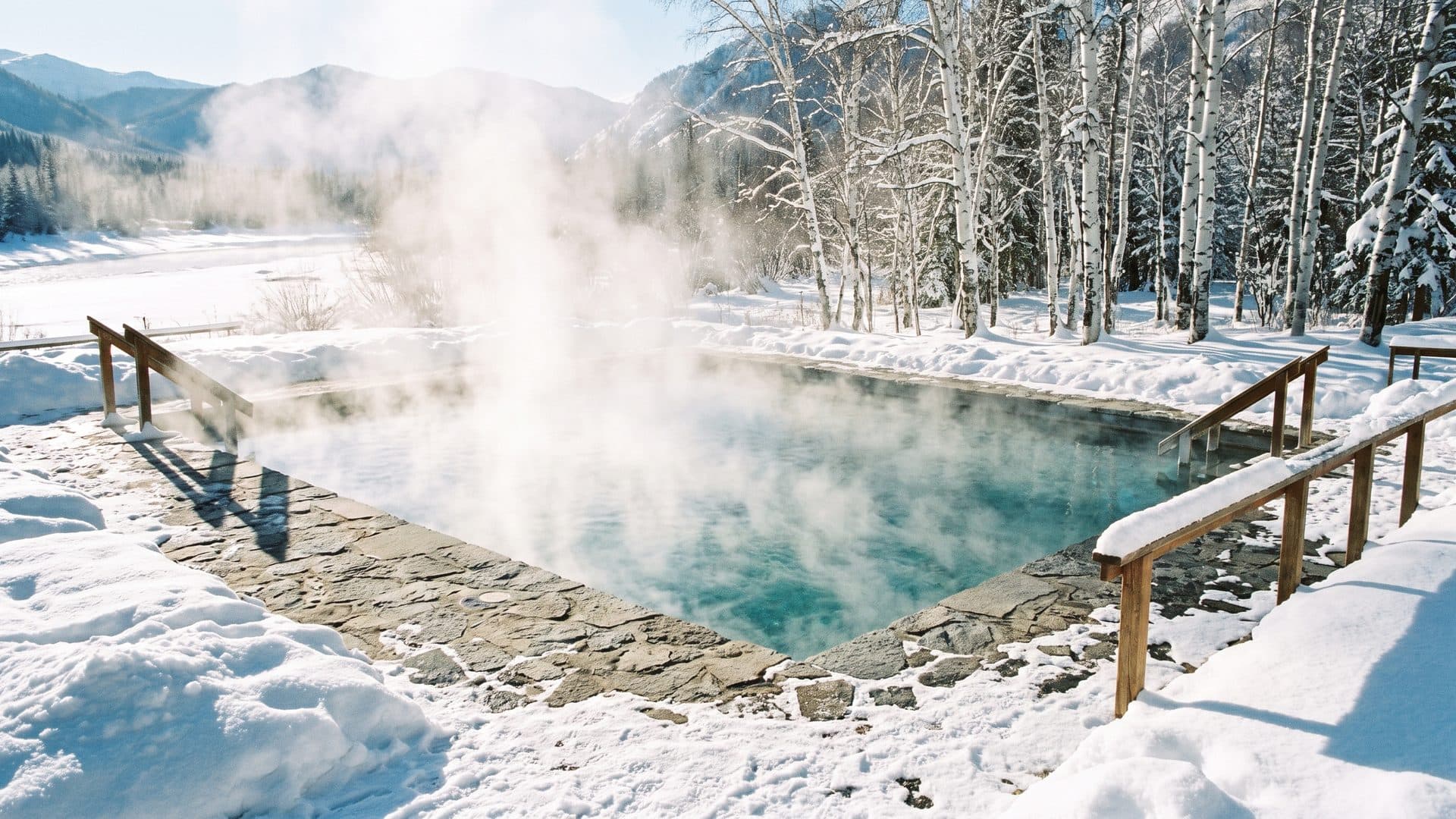
And look at the season. An outdoor basin in January is the photograph that sells a Bavarian Therme, and at Erding two-thirds of the thermal area is outside. Outdoor pools elsewhere do not all run all winter, so check the bath's pool list for the month you go. If sitting in warm water with snow on the railing is the point of your trip, our piece on outdoor pools that stay open in winter says what to check.
The list under this article holds all 14 thermal baths in the box around Munich, from the oil well at Erding to the salt grotto at Bad Reichenhall. Pick by what you want the water to do, then read that bath's own pool list and house rules before you set off.