According to the legend Lüneburg tells about itself, a hunter once shot a wild boar that was snow-white. The colour turned out to be salt: the animal had been wallowing in a salt spring, and the crust had dried on its bristles. The story is set around the year 800. What came after is documented. At the centre of the town's saltworks stood the well, the Sod, and around it 54 boiling houses with four pans each, 216 pans in all, fed with brine from the same source. A man who leased at least four of them was called a Sülfmeister and was entitled to a boiling house of his own. The saltworks produced salt until 1980.
The brine is still there. Salztherme Lüneburg, the SaLü, says the salt in its pools is the same salt that made Lüneburg rich and famous, and publishes the strength of its Starksole: 26 per cent. Nobody bathes in that. Six of the bath's pools carry brine, let down to 1.5 per cent in the wave pool and the outdoor pond, 2 in two others and 4 in the strongest. One source, six pools, three strengths, chosen pool by pool.
That is the first thing to know about a brine bath. The word tells you where the salt came from, not how salty the water will be. And the best-known brine baths stand in old salt towns that found a second trade when the first one faded.
What counts as Sole?
In German spa terminology the line is drawn precisely. The Begriffsbestimmungen, the definitions published by the Deutscher Heilbäderverband with the German tourism association and used by the federal states when they grant spa titles, say that water with at least 5.5 g of sodium and 8.5 g of chloride per litre may carry the conventional name Sole. That is about 14 g of dissolved rock salt per litre, roughly 1.4 per cent. The threshold describes the source. What is in the pool is whatever the operator dilutes it to, and a published percentage is the number that tells you how the water will feel.
Salt towns that became spa towns
Bad Ischl and the salt princes
Salt was mined at Ischl from 1563; the bathing came through one doctor. Franz Wirer, a former army surgeon who became court physician to Emperor Franz I and rector of the University of Vienna, sent the first forty patients to try brine baths at Ischl in 1822. The town counts its cures from that summer. The next year he and Josef Götz opened the first brine bathing house in Austria.
Among the early guests was Archduchess Sophie, the wife of Archduke Franz Karl. The account published by the Schönbrunn palace company tells it plainly: after five miscarriages in the first five years of her marriage, she took the waters at Ischl, and a year later she gave birth to the boy who became Emperor Franz Joseph. Her sons were known as the "salt princes". Franz Joseph chose Ischl as his summer home in 1849, and was given the Kaiservilla there as a wedding present.
The town's bath today is the EurothermenResort Bad Ischl. Its operator describes the local brine as a site-bound natural remedy at 25 to 30 g of salt per litre, and gives the salt content of the bathing water as 3 per cent, which it compares to the Adriatic. The treatments still run on brine, from mud packs to inhalation, and the operator notes, modestly, that the imperial family took salt cures here.
Bad Reichenhall and the oldest pipeline
Bad Reichenhall has been making salt from its brine springs since about 450 BC, according to Wikipedia. By the early seventeenth century the forests around the town could no longer feed the boiling pans. So between 1617 and 1619 the court architect Hanns Reiffenstuel and his son Simon laid a wooden pipeline that carried the brine 31 km to Traunstein, where there was wood to boil it with. Seven pump houses, their piston pumps driven by water wheels, lifted it over the hills. In 1808 the engineer Georg von Reichenbach extended the line to Rosenheim. It was shut down on 1 July 1958.
The brine now goes a much shorter way. The operator of the Spa & Familien Resort RupertusTherme says it is piped from the town's saltworks directly into the bath. The name is a dedication: Saint Rupert is the patron of salt mining and of salt workers. The thermal pools run at 2 per cent. Underground is the Soleschwebebecken, a floating pool at 12 per cent, which the operator likens to an enchanted salt lake.
Bad Dürrheim and the borehole of 1822
In 1822, boreholes sunk under the mining official Carl Josef Selb struck an underground salt deposit at Dürrheim, between the Black Forest and the Swabian Alb. A saltworks followed within a few years, and from 1883 the brine was also used for bathing cures. Solemar, opened in 1987 beside the spa gardens, keeps 13 indoor and outdoor pools at 3 to 7 per cent, a graduation tower, and a salt grotto that uses Dead Sea salt rather than the local brine.
Salins-les-Bains and the river that pumps
In the Jura, at Salins-les-Bains, there were already two saltworks by 1115. The great saltworks closed in 1962, but its underground gallery from the thirteenth century survives, 165 metres long and six to seven metres high, and so do pumping mechanisms driven by the current of the river Furieuse, still in working order. Brine travelled 21 km by pipeline from here to the Royal Saltworks at Arc-et-Senans, built in 1775–79 beside a forest big enough to fuel it. Since 2009 Salins has shared that site's place on the UNESCO World Heritage list.
Salt water from the Muyre well has fed baths in the town since 1854. At ThermaSalina the treatment water comes from the Puits des Cordeliers, nearly 150 metres down, while the less salty Muyre water fills the pools of the relaxation area. One rule there surprises families: children under twelve are not admitted to it.
What is a graduation tower for?
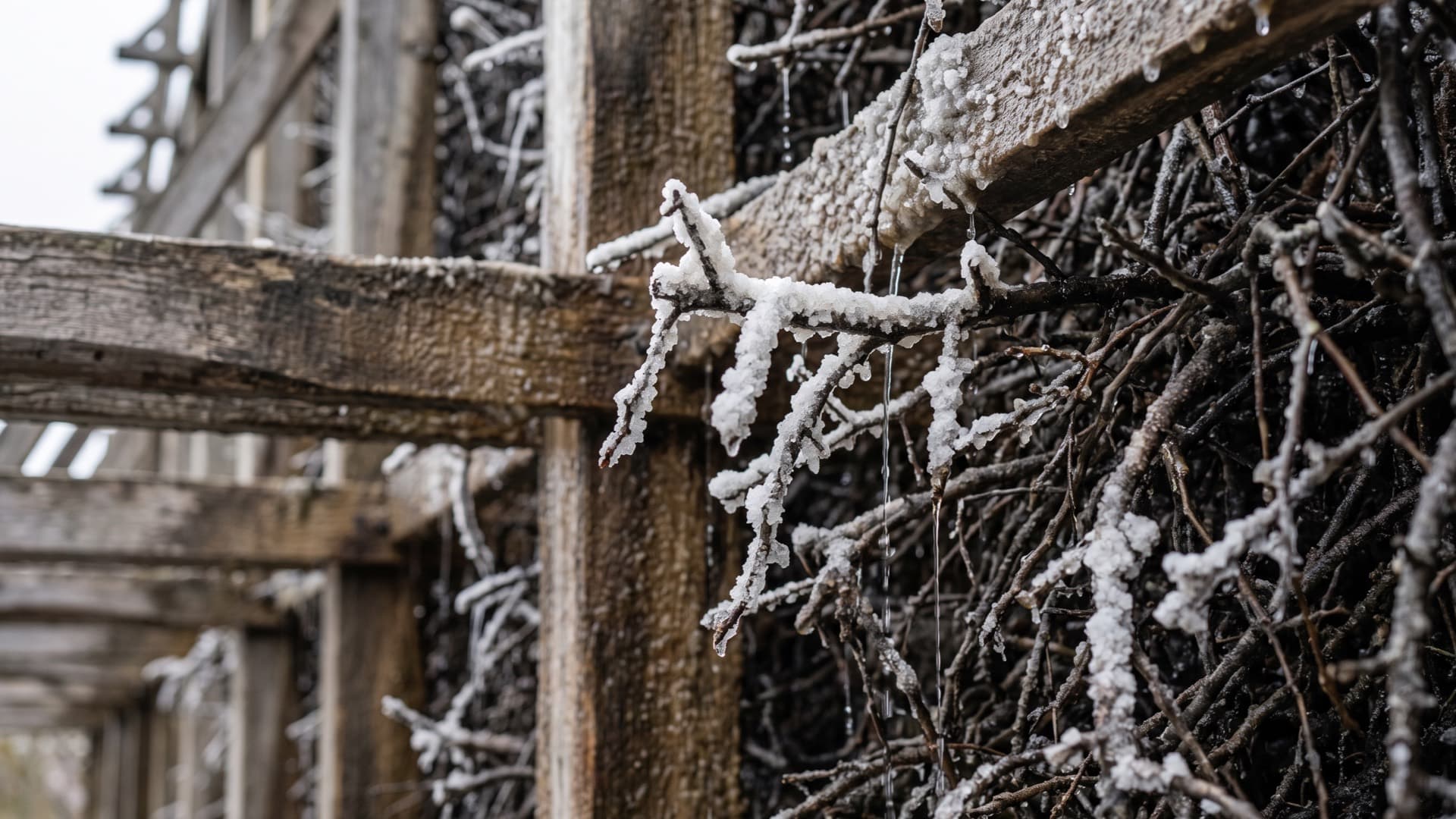
The structure on the cover is older than any of these pools. A graduation tower, Gradierwerk in German and tężnia in Polish, is a tall timber frame packed with bundles of blackthorn. Brine is pumped to the top and trickles down through the twigs; the wind takes part of the water, and the brine that collects at the bottom is stronger than the brine that went in. Lime and gypsum settle on the thorns as a grey-brown crust, Dornstein, until the blackthorn has to be replaced.
The point was fuel again. Salt was won by boiling brine down, and every litre the wind removed first was a litre the pans did not have to burn wood for. At Bad Salzelmen, now part of Schönebeck on the Elbe, the Prussian state built a tower between 1756 and 1765 that eventually reached 1,837 metres. Germany's first brine spa opened there in 1802, and a section of the tower still stands as an open-air inhalation site. The town's brine bath today is Solequell.
The towers at Ciechocinek, on the Vistula in Poland, were designed by Jakub Graff, a professor at the Mining Academy in Kielce. Two were built in 1824–28 and a third in 1859; together they run to 1,741.5 metres, and stand 15.8 metres high. Brine comes up from spring no. 11 at about 5.8 per cent and leaves the strongest tower at 30. The surprising part is that they still work: the brine from the towers goes on to the town's salt-boiling house, which makes salt, mud and therapeutic lye. The spa company, Uzdrowisko Ciechocinek, draws on the same spring, about 415 metres deep.
Once salt could be made more cheaply, the towers found a second life. Their salty air came to be treated as a cure, much like sea air, and some were built for nothing else. Lüneburg's, about 59 metres long and 10 high in the spa gardens, went up in 1907 and never produced a grain of salt; breathing beside it, the operator notes, costs nothing. Jod-Sole Therme Bad Bevensen and Solemar each have one on site.
How is a brine pool different from sea water?
By origin first, and only then by strength. Ocean water averages about 3.5 per cent salt; the Baltic is under one per cent at the surface. Spa brine comes from underground, from salt deposits laid down when old seas dried out and dissolved again by groundwater.
At the low end the strengths overlap. Bad Ischl's 3 per cent and Lüneburg's 4 sit either side of the ocean average. The source brines are many times saltier than any open sea; only closed lakes come near them, the Dead Sea at about 34 per cent. Some brines carry iodide, hence a name like Jod-Sole: Bad Bevensen draws on two boreholes, 700 and 661 metres deep, at 10.3 and 11.7 per cent.
Is a brine pool the same as a salt room?
No, although the marketing often blurs them. A brine pool is something you get into. A salt room, a Salzgrotte or grota solna, is a room lined with salt where you sit and breathe, sometimes with a machine that disperses fine dry salt into the air. Halotherapy, as it is called, traces its modern story to a Polish physician, Feliks Boczkowski, who observed in 1843 that salt miners had fewer lung complaints than other miners. Reviews since have found little rigorous evidence for its effects, so any benefit a venue describes is what the operator states.
25 of the 95 venues with a brine pool have a salt room as well. Solemar is one, and its Dead Sea grotto is the reminder that the salt on the walls and the salt in the water need not come from the same place.
Can you float in a brine pool?
In a few. Bad Reichenhall's 12 per cent floating pool is built for lying on the surface rather than swimming through it. At 1.5 to 4 per cent, the strength of most brine pools, the water holds you a little better than fresh water, closer to the sea than to the Dead Sea. If floating is the point, look for a percentage and a word like Schweben attached to a specific pool.
Your first visit
A brine bath looks like any other until you get in: salt on your lips, and every small cut from that morning's shave. Keep the water out of your eyes. Lüneburg asks everyone to shower thoroughly with soap and shampoo before going into any pool, and afterwards you will want a fresh-water shower too, because salt that dries on skin and swimwear itches.
Ask which pools are brine. At the SaLü six of twelve pools and whirlpools carry it, and the sports pool is fresh water; in a leisure bath it may be one salted basin among several. Of the 95 venues, 19 hold an official medicinal-water certification and 12 name sodium and chloride in a published analysis; elsewhere the listing says there is salt water, not how strong. Our guide to certified medicinal water explains what the certificate involves.
Healing claims on a bath's website are the operator's statements, not medical advice. If you have a heart or circulation condition, are pregnant, or are unsure, ask your doctor before booking a brine cure.
Germany has 69 of the 95 venues listed under this article, and the map follows the salt: the Lüneburg and Bevensen baths on the North German plain, Bad Reichenhall and Bad Ischl in the Alps, Ciechocinek's towers on the Vistula, ThermaSalina in the Jura. Pick one in a salt town, and leave time for the saltworks museum or the tower walk before you get in.