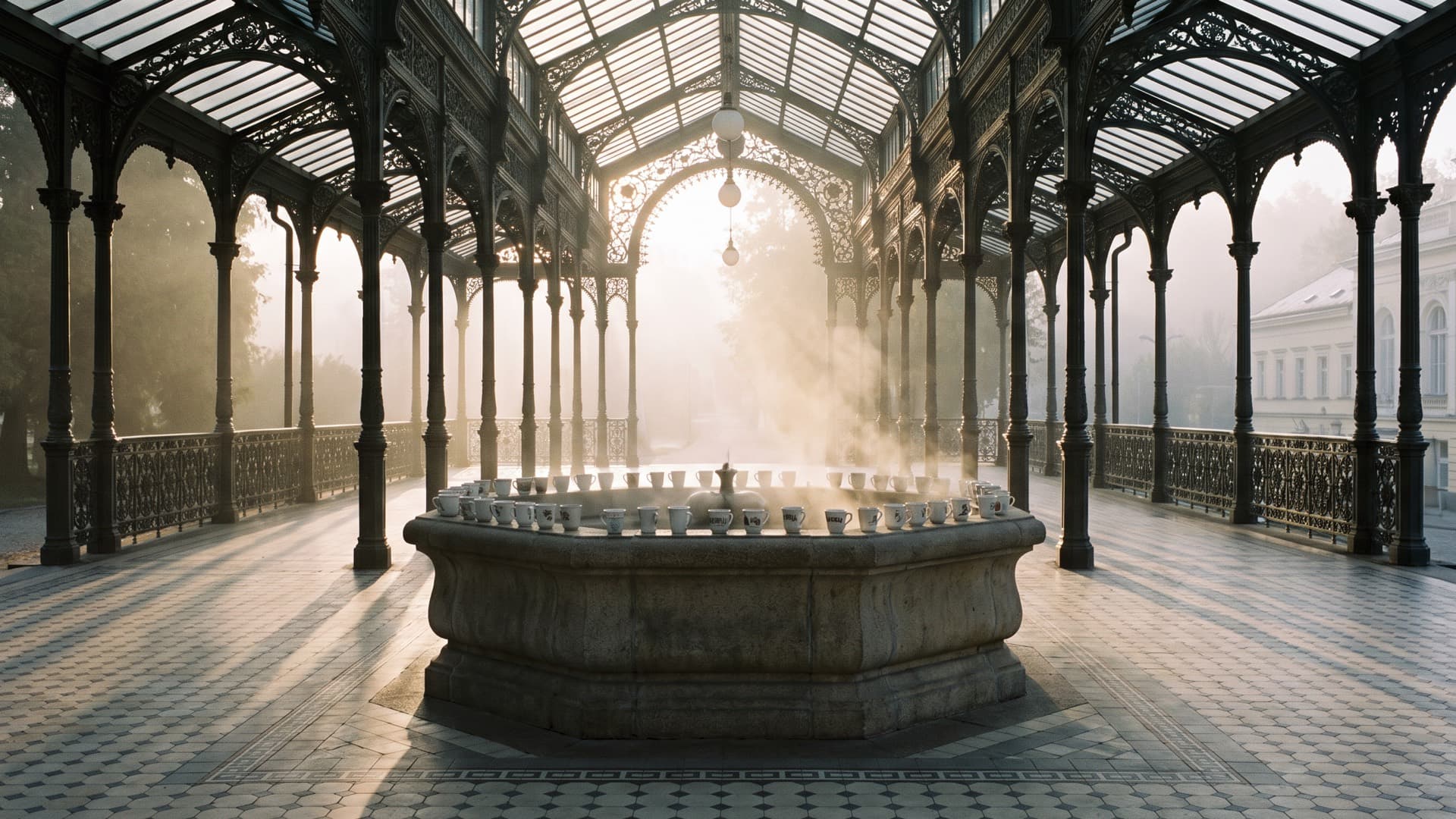
Inside a functionalist hall in Karlovy Vary, built in 1975, a column of water shoots up to twelve metres into the air. It is Vřídlo, the Hot Spring, and Visit Czechia, the national tourism agency, gives its temperature as 72 °C and its flow as about 2,000 litres a minute. Wikipedia calls it the hottest spring in the Czech Republic. It feeds the town's spa baths, and Visit Czechia notes that it is used for drinking cures too, sipped from a small porcelain cup.
That cup tells you most of what you need to know about the three spa towns of West Bohemia. Karlovy Vary, Mariánské Lázně and Františkovy Lázně lie within an hour's drive of one another near the German border, and in 2021 UNESCO inscribed all three, alongside spa towns in other countries, as the Great Spa Towns of Europe. They were built for drinking water. Bathing came second, and the kind of bath you get depends on which town you are in: a pool, a tub, or a room full of carbon dioxide.
Is the water in the Czech spa towns hot?
In one of them. Visit Czechia calls Vřídlo the only source of thermal water used for the spa baths of Karlovy Vary. More than eighty springs rise in the town in all; the town's own site says the public can drink from fifteen of them, and that they differ in temperature and in how much carbon dioxide they carry.
Mariánské Lázně and Františkovy Lázně sit on different geology. Wikipedia counts a hundred mineral springs in and around Mariánské Lázně, forty of them in the town itself, and describes them as cold carbon-dioxide springs, often rich in iron, at an average of 7–10 °C. Františkovy Lázně gives 9–11 °C for its springs all year round. Nobody would sit in that water as it leaves the ground. What both towns have instead is gas. The water fizzes, and Františkovy Lázně notes that when you lower a hand into one of its baths, small bubbles of carbon dioxide form on the skin.
A warm pool and a warm spring are not the same thing, and the word on the sign does not settle which you have; the piece on what "Therme" means goes into why.
Karlovy Vary
The legend says Charles IV's hunting party found the hot spring by accident and that the water healed his injured leg. The record is plainer: Wikipedia dates the town to around 1349 and the privileges Charles granted it to 14 August 1370. What you walk through today is mostly nineteenth-century. The Mill Colonnade, a pseudo-Renaissance hall of 1871–1881, is the largest and shelters five springs. The Park and Market Colonnades of the early 1880s are by Fellner & Helmer, and the Imperial Spa, a French neo-Renaissance bathhouse, went up between 1893 and 1895.
Bathing here means Vřídlo water, cooled. It is piped to spa houses and hotel pools in the town and brought down from its spring temperature to something a body can take. The European Spas Association describes one hotel pool filled daily with spring water adjusted from 73 °C to 38 °C.
Mariánské Lázně
Mariánské Lázně is younger. It became a watering place in 1818, developed by the abbots of the nearby Teplá monastery, and drew a run of guests that Wikipedia takes from Goethe to Edward VII. Its centrepiece is the Colonnade, a neo-Baroque cast-iron hall built in 1888–1889 to plans by the Viennese architects Miksch and Niedzielský. According to the town, the ironwork was cast at Blansko in Moravia and arrived in pieces by train. It was restored between 1973 and 1981, and the ceiling frescoes are by Josef Vyleťal.
The place to get into the water is Nové lázně, the New Baths, rebuilt between 1893 and 1896 by Josef Schaffer as a four-towered neo-Renaissance palace. Its operator describes the Roman Baths inside as two original mineral-water pools among marble columns and classical statues, an 1896 interior that came through two world wars, with a third pool added later. The house also keeps the Royal Cabin, a private bathing suite made in 1896 for Edward VII. One of its carved chairs hides a scale, so the king could check his weight sitting down. The operator sells the baths as part of hotel stays, so whether you can come in for a single visit is a question for the front desk.
Františkovy Lázně
The smallest of the three was founded on 27 April 1793 as Kaiser Franzensdorf, named after Emperor Francis II, and it began with a riot. In 1791 a doctor named Bernhard Adler had a pavilion and basin built at the Franzensquelle. The women of nearby Cheb who carried the spring water into town for a living saw their trade threatened and tore it down. The spa was founded two years later all the same.
What Františkovy Lázně does with cold water, and with the ground around it, is its own. The town's description of its natural resources lists bath water heated to the required temperature; a dry gas bath, in which carbon dioxide of volcanic origin from the Marie source flows down from the well gallery and fills the room to about mid-calf; and iron-sulphate peat pulp for peat baths and wraps. For swimming there is Aquaforum, with four indoor and three outdoor pools, a toboggan and swimming pools kept at no less than 28 °C, according to the town's information site, which calls it the largest spa aquapark in the Czech Republic.
How does the drinking cure work?
Slowly, and on prescription. The Karlovy Vary tourism site tells visitors to follow the drinking cure their spa physician has set, to use 200 ml cups, to take each one over three to ten minutes and to leave five to ten minutes between cups. Walking while you drink is part of it. That is why the colonnades are long covered promenades rather than pump rooms: the architecture is built around a slow walk with a cup in your hand.
The cup is the thing visitors carry home. According to the Great Spa Towns of Europe association, porcelain spa cups replaced the earlier ones of tin and glass, and the spout built into the cup let people sip as they walked. They are on sale near every spring. Because the springs differ in temperature and gas, the same cup filled at two fountains a short walk apart can taste quite different. Which one you drink from is meant to be the physician's choice, not the walker's.
What the water is said to treat is for the operators to state, and they do. Františkovy Lázně lists circulatory, musculoskeletal, gynaecological, digestive, skin, nervous and metabolic conditions, and care after cancer treatment, among its indications. That is the operator's list, not a recommendation. If you have a condition, ask your doctor before you plan a cure around it.
Where else in Czechia can you bathe in warm water?
Beyond the triangle, mostly in places the triangle overshadows. Of the 30 Czech venues listed with this article, 19 are water parks, the large indoor complexes of Czech cities, warm because they are heated. 11 are thermal baths, the spa side of the country, and 8 Czech venues in all hold an official medicinal-water certification.
Two stand out if you want to sit in naturally warm water. Lázně Teplice v Čechách, in the north, is in a town whose springs are fabled to have been found in 762 and were first mentioned in 1154, which makes it, Wikipedia says, the oldest spa in the country. In 1812 Beethoven and Goethe met there. In the foothills of the Jeseníky mountains, Termály Losiny draws what its operator calls a natural healing spring from a depth of more than 1,000 metres, with water up to 36 °C, spread across nine thermal pools.
The chemistry varies more than the triangle suggests: 3 Czech baths name sulphur among the main constituents of their water. The article on sulphur thermal water explains what that word in an analysis does and does not tell you, and certified medicinal water what the certification means.
Is a trip to the spa triangle worth it if you only want to swim?
It depends what you mean by swim. If you want a long thermal pool and a day ticket, the triangle was not built for that. If you are curious about an older kind of spa culture, with its walk and its cup, a bath taken alone in a tiled room and a gas that pools around your ankles, then these three towns are where it still runs. You can finish the day in a pool all the same: Roman marble in Mariánské Lázně, a water park in Františkovy Lázně.
Two things are worth knowing before you go. Much of the bathing is sold as treatments and hotel packages, so ask the operator whether you can come for a single visit. And the drinking springs in the colonnades are public and free to use, so the part of the trip that made these towns famous needs no booking at all.
Getting between them
Františkovy Lázně is the westernmost, close to Cheb. Mariánské Lázně lies to the south-east of it, and Karlovy Vary further east. Many visitors base themselves in one town and treat the other two as day trips, which works because the colonnades and springs are the sights.
The 30 Czech venues after this article run from the marble pools of Nové lázně and the seven pools of Aquaforum to the deep-well water of Termály Losiny and the country's heated city water parks. If warm water is the point of the trip, start with the thermal baths, and keep the colonnades for a slow morning walk with a cup.