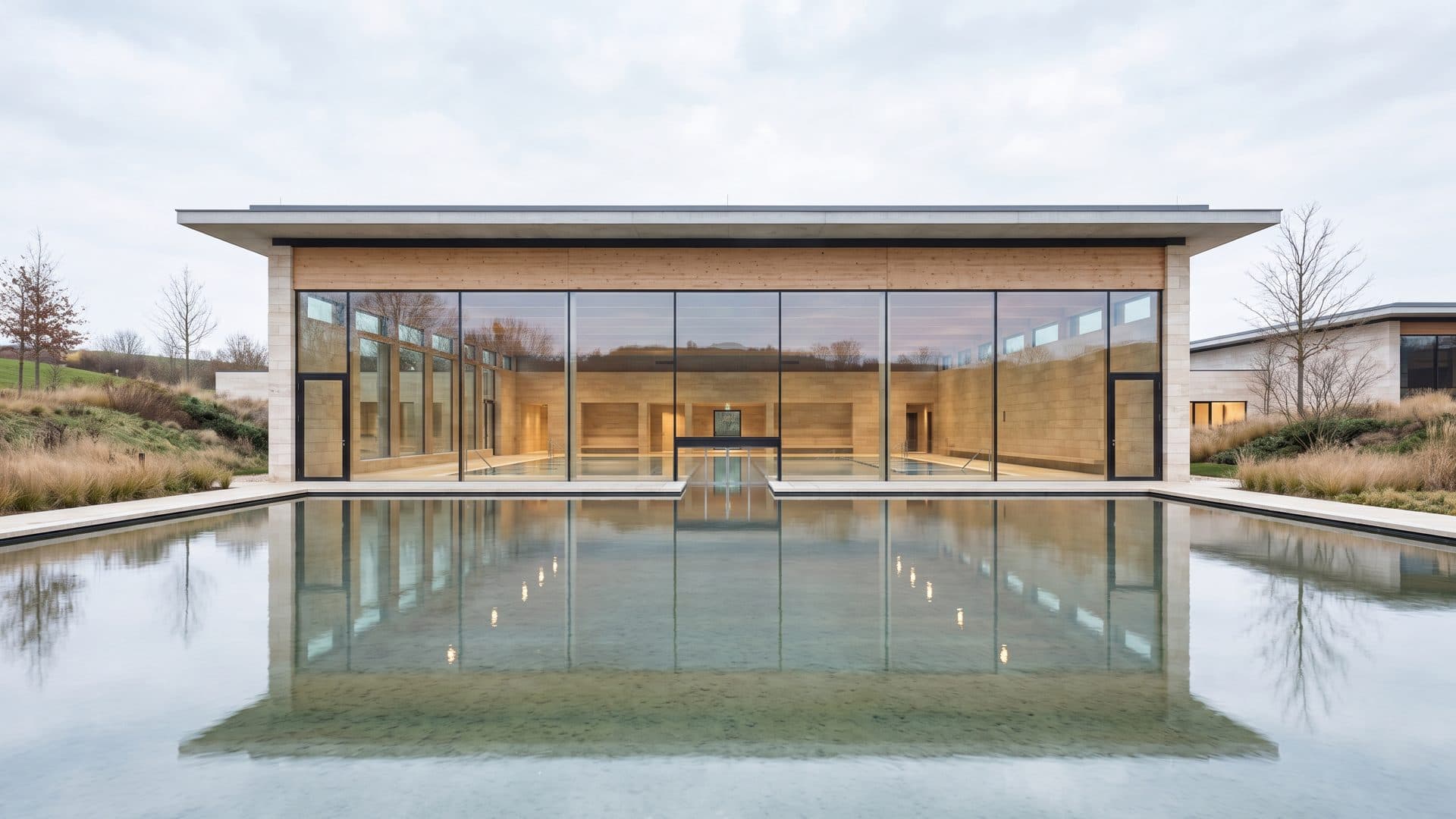
The Baths of Caracalla were inaugurated in Rome in AD 216, and they were fed by a new aqueduct, the Aqua Antoniniana, a branch of the Aqua Marcia. Under the floors, in tunnels that also stored the fuel, furnaces burned an estimated ten tons of wood a day to heat the water.
Romans called complexes like this thermae, from the Greek thermos, hot. The word once meant warm springs, but by the time of the empire it meant the great public bath houses, wherever their heat came from. One of the great thermae of antiquity, in other words, ran on aqueduct water heated by fire.
Eighteen centuries later the emperor's name hangs over a bath in Baden-Baden whose water needs no fire at all. Caracalla Therme was built in 1985, and its operator credits Caracalla with bringing the town's bathing culture to its first golden age. The water comes from about 2,000 metres down and reaches the surface at up to 68.8 °C from twelve sodium chloride springs at the foot of the Florentinerberg. It has to be cooled with fresh water before anyone can get in. Same word, opposite story.
That gap is the subject here. 389 baths carry a thermal word in their name: Therme, terme, termál, termy, thermes. What the word promises depends almost entirely on which country you read it in.
Does “Therme” on the sign mean the water is thermal?
In Germany, not by law. "The term Thermalbad is not protected by law," Rainer Stange, an internist at the Charité in Berlin, told the consumer magazine test in 2019. Therme is a looser word still. The 20 °C line you may have heard of is a convention of the spa associations: a natural spring whose water is at least 20 °C where it leaves the ground.
What the German state does control is a different word. A town may put Bad in front of its name only after the state has recognised it as a spa. In Lower Saxony, for instance, the municipal code ties the prefix to official recognition as a Heilbad or Kneipp spa. A spring used for treatment needs its own recognition too: in Bavaria it must be a staatliche Heilquelle, assessed by expert institutes and approved by the regional government. So in Germany the useful words on the sign are the town's prefix and anything that says Heil-. The Therme is the bath's own choice.
Of the 389 baths with a thermal word in their name, 148 publish the temperature of their spring and 127 use water recognised as medicinal. For the rest, the word alone tells you nothing.
Italy: the word is the law
Italy went the other way. Law 323 of 2000, the reform of the thermal sector, defines acque termali as natural mineral waters used for therapy, and its second article lists the words that only the real thing may use: terme, termale, acqua termale, fango termale, idrotermale, thermae among them. Since a rewrite in 2024 they are reserved for licensed thermal establishments and the treatments those establishments provide.
The courts have taken it literally. In 2025 the regional administrative court of Lazio held that using terme where no thermal water is used breaks the rules even if the brochure explains the difference, and in May 2026 the Consiglio di Stato, Italy's highest administrative court, upheld it in a case brought by the spa company of Sirmione against a wellness operator. Its reasoning was that the word in a name is enough on its own to make a customer believe they are in a real thermal establishment.
Notice what the definition leaves out. Temperature is not in it. An Italian terme is a place with recognised mineral water and a medical licence, and the water can be cold. At Terme di Gambassi, in Tuscany, the Acqua Salsa di Pillo comes up at 15 °C, and the operator calls it exactly what it is, a cold thermal water. It is salty, with bromine and iodine, and is used for drinking cures and inhalations. The operator thinks the Etruscans knew the spring, which lies near the old road from Fiesole to Volterra. In 1861 it belonged to a Florentine nobleman, Marchese Ludovico Incontri, who let people take the water freely, and it earned the nickname "the poor man's Montecatini". The town captured the spring in 1964 and pipes its water 3.8 kilometres to the baths. Our guide to Italian thermal baths covers the hot ones.
France: thermal means medicinal
In nineteenth-century France, thermal water was defined by heat, above 20 °C at the source. The definition changed: today any natural mineral water used for a cure is called thermal. Running it needs a ministerial authorisation after an opinion from the Académie nationale de médecine, and the water has to be delivered as it comes from the source, without treatment. The standard cure lasts three weeks, eighteen days of them treatment.
La Roche-Posay, in the Vienne, shows how far that is from the German idea. Its water, the operator says, seeps slowly through chalk and is drawn from 30 to 80 metres down. It comes out at 13 °C, low in minerals, with 53 micrograms of selenium per litre. The Thermes du Connétable opened in 1932, and in the years between the wars André Gide and Jean Cocteau stayed in the town. A day here is nothing like a day at a Therme: the operator describes a filiform shower given by a doctor, multi-jet showers and bubble baths, and lists eczema, psoriasis, scars and burns and care after cancer among its cures. Those are the operator's indications. A cure is something to discuss with your doctor, who is also the person who prescribes it.
The town that named the spa
The English word spa comes from Spa, a small town in the Belgian Ardennes with more than 300 cold mineral springs. Where the name itself comes from is uncertain. The popular explanation, salus per aquam, health through water, is a backronym invented afterwards. Italy wrote it into its thermal law anyway, as spa (salus per aquam), and the 2024 rewrite dropped it from the list.
Les Thermes de Spa sits on a hill above the town and uses three of those springs. The Clémentine, a calcium bicarbonate water, is heated to 33 °C for the main pools. The Marie-Henriette is naturally full of gas and carries the iron that gives it a rust colour; it is used for carbonated baths in copper tubs, which the operator says the water needs for its chemistry. Peter the Great is among the guests the operator lists. Our piece on iron water explains the rust.
What do toplice, banja and termál mean?
East of the Alps the thermal words are older than any marketing, because they are place names. Dolenjske Toplice in Slovenia takes its name from the Slovene toplica, hot spring; the village was first recorded as Topliz in 1228, and the Counts of Auersperg established the baths in 1658. Its bath today is called Terme Dolenjske Toplice, which says the same thing twice, once in Italian and once in Slovene.
Ilidža, on the edge of Sarajevo, goes one better. The town's name comes from the Turkish ılıca, warm springs, and the Romans knew the settlement as Aquae Sulphurae. The spa there is Banja Therme Ilidža: banja is the Slavic word for a bath, Therme the international one, Ilidža the Turkish one, three languages over one door. The operator gives its water as sulphurous and 57.5 °C, and lists rheumatic diseases and spinal conditions among its indications. Sulphur water has its own smell and its own article.
On the Sea of Marmara a whole district took the word. Termal, near Yalova, is named after the Greek thermai. The state-run baths there, Yalova Termal Kaplıcaları, operated by Turkey's Ministry of Health, tell their own history: the first bath houses are credited to the emperor Constantine, the springs became famous again when the mother of Sultan Abdülmecid came to cure her rheumatism, and Abdülhamid II commissioned the first water analyses. The Kurşunlu bath, named for its lead roof, was excavated and restored under Abdülhamid in 1900. Atatürk arrived on 19 August 1929, and the operator quotes him: "This will be the water city of the future."
Polish works the same way. Cieplice, now part of Jelenia Góra, was named after the warm springs first recorded there in 1281. Its modern bath, Termy Cieplickie, draws water from a well more than 2,000 metres deep, at up to 87 °C, and mixes it with spring water to bring the pools down to 27–36 °C. The operator lists Goethe and John Quincy Adams among the people who once came for the waters of the old spa.
Hungarian has two words, and only one of them is granted. Termál describes warm water, above 30–31 °C in Hungarian usage. Gyógy-, medicinal, is a designation a state authority awards to a particular water. A name like Agárdi Gyógy- és Termálfürdő makes both claims, and the second is the one with paperwork behind it. Our guide to certified medicinal water explains how that works.
Do real thermal baths always call themselves Therme?
No. Of 672 thermal baths, 57% carry a thermal word in their name. The rest are called something else: a fürdő, a lázně, a kúpele, a plain town name. A bath built on a spring in the nineteenth century had no reason to borrow a word that leisure developers later made fashionable. And at the other end, 7 of the baths with a thermal word in their name publish a spring temperature below 20 °C, like Gambassi and La Roche-Posay. Neither is a mistake: there the word means something other than heat. The three words that do have definitions, thermal, mineral and medicinal, get a piece of their own.
How can you tell what is in the water before you go?
Start with the country, because it tells you how to read the word. In Italy the word is a licence and in France a medical category. In Germany it is a brand. In the Balkans and Turkey it is often a place name with history attached.
Then look for two numbers on the operator's site. The first is the temperature where the water leaves the ground, ideally with the depth of the well. The second is the temperature of the pools. They are different on purpose. Caracalla's 68.8 °C is cooled with fresh water, Cieplice's 87 °C is mixed with spring water, and Spa's Clémentine is heated to 33 °C. All three are honest; they just answer different questions. If you want to sit still in warm water for half an hour, the pool figure is the one that matters.
Look for the analysis too, in milligrams per litre: Caracalla publishes 1,450 mg of chloride, La Roche-Posay its selenium. And look for the official word in the local language, Heilwasser or gyógyvíz, rather than the word on the sign.
Read the house rules at home. They vary more than the water does. At Caracalla Therme children are admitted from the age of seven, under-fourteens only with an adult, swimwear is required in the pools and the sauna area is textile-free; our guide to textile-free bathing explains that custom. At La Roche-Posay you are booking a medical cure, and a doctor is part of the day. If you have a heart or circulation condition, high blood pressure, or are pregnant, ask your own doctor before a course of thermal treatment anywhere.
The word on the sign is a decent first clue in Italy and France, and a pleasant bit of history in Ilidža or Termal. In Baden-Baden it is the name of an emperor who heated his baths with wood. The spring temperature tells you more than any of them.