In the Erzgebirge, the wooded hills on the border between Saxony and Bohemia, the fire in one sauna at Badegärten Eibenstock is lit long before anyone gets to sit in it. The Karelische Rauchsauna has no chimney. Wood burns in an open stone oven for five to seven hours, the smoke finds its way out through slits in the walls and ceiling, and only when the fire has died and the room has been thoroughly aired are guests let in. The walls are black with soot. The benches sit high up, like balconies, and the operator says the heat that comes off the blackened timber is "seidenweich", silky-soft. It reaches 70 °C, which by Finnish standards is mild, and the operator traces this kind of room back to the Kalevala, the Finnish national epic, which describes it in detail.
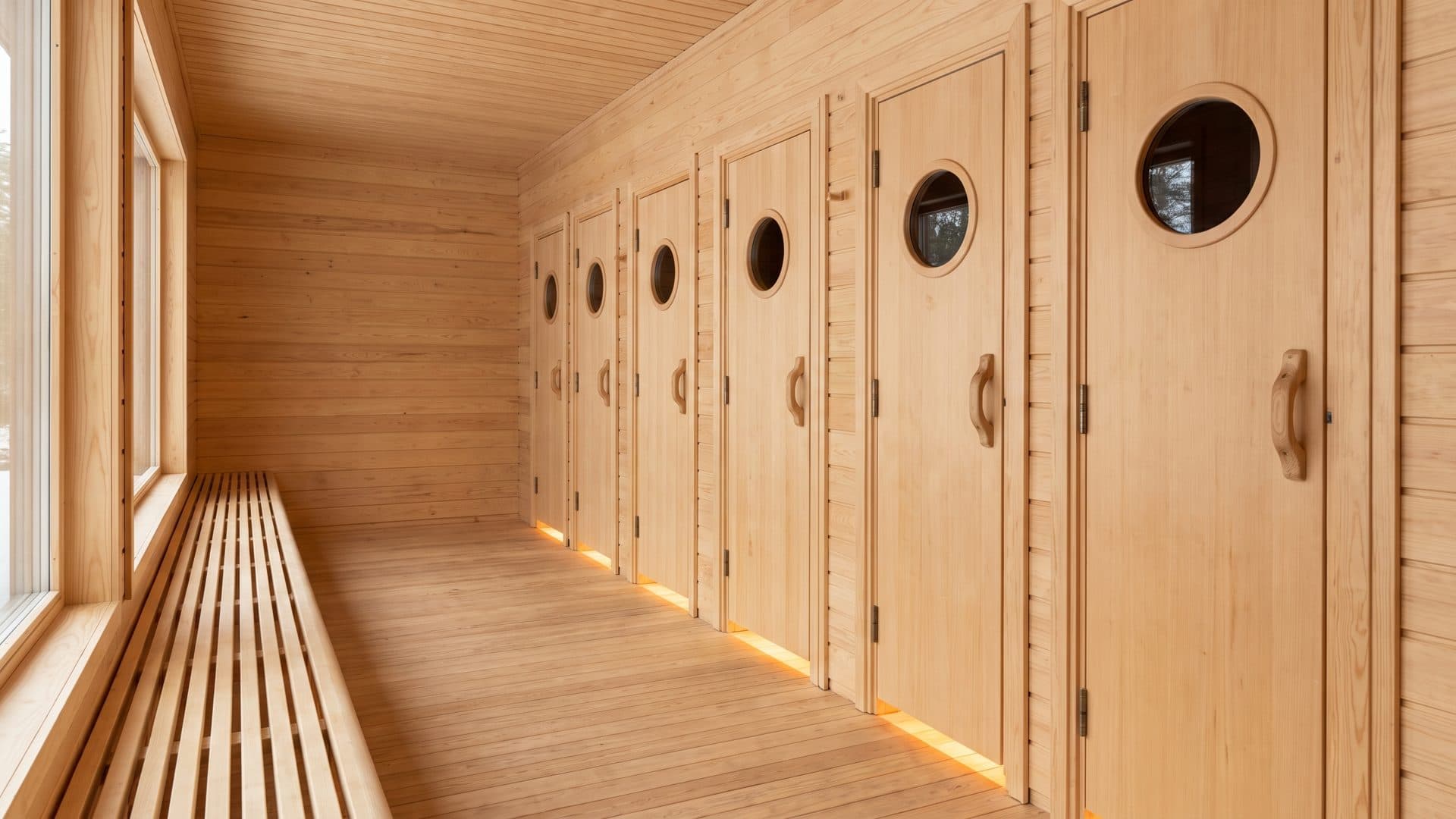
That is one door. A large sauna world may have a dozen, and the signs assume you know the language: Finnish, bio, caldarium, tepidarium, infrared, banya, hammam. Almost every one of those words describes two things, how hot the air is and how much water it holds, and sometimes a ritual that comes with the room.
358 baths, water parks and sauna houses say they have a sauna. 294 of them are thermal baths, 59 are water parks, and 119 are in Germany. The words on their doors come from Finland, Russia, Rome, the Ottoman Empire and Korea.
How hot is a Finnish sauna, and why can you stand it?
Wikipedia gives a traditional one at roughly 75–100 °C, sometimes above 110 °C, with the hottest rooms also the driest. That dryness is why you can bear it: dry air carries your sweat away, while the same heat in saturated air would be unbearable. When someone throws water on the stones, the burst of moist heat that rolls down from the ceiling has a Finnish name, löyly, the steam and the heat of a sauna together.
UNESCO added sauna culture in Finland to its list of intangible heritage in 2020. Official registers count at least two million saunas in a country of five and a half million people.
At Värska veekeskus, in Setomaa in the south-east corner of Estonia, the sauna menu is written in the Estonian version of that vocabulary. There are two leilisaun, named for the Estonian cousin of löyly: one at 75 °C, which the operator recommends to people who like a soft löyly, and one at 90 °C for those who want intense heat and a cold plunge after it. The plunge pool in the foyer is filled with cold natural mineral water. Read any Finnish-type door that way: the number on the sign is the difference, and the hotter room is not the better one.
Smoke and earth: the old forms
The first Finnish saunas were smoke saunas, the savusauna. Wikipedia says a properly heated one gives off heat for up to twelve hours. In southern Estonia the custom is still domestic: in 2014 UNESCO inscribed the smoke sauna tradition of Võromaa, a family practice usually kept on Saturdays, in which an older relative prepares the sauna while the children learn. The listing includes making bath whisks and smoking meat in the sauna.
Eibenstock also has an Erdsauna, sunk into the ground and built of thick logs, which the operator calls the original form of the Finnish sauna. It runs at 110 °C in very dry air; next to it, the 70 °C smoke sauna is the gentler start.
What is the difference between a Finnish sauna, a bio-sauna and an infrared cabin?
The bio-sauna, sometimes sold under the trade name Sanarium, is the compromise room of German spas. German Wikipedia gives it as usually about 45–60 °C at a humidity of around 40–55%. It is considered easier on the circulation, often comes with coloured light and essential oils, and people stay longer. If you have never been in a sauna, open this door first.
The Baltic sauna sits in a similar band: Wikipedia puts it at about 55–70 °C with 60–90% humidity. In Aachen, Carolus Thermen gives part of its sauna world to Baltic sauna culture, beside saunas at different temperatures and three steam baths. It is a nude area, and the operator says plainly that there are no swimwear days. If that is new to you, our guide to textile-free bathing explains the custom.
The infrared cabin is the odd one out. Every other room heats the air, and the air heats you. An infrared cabin warms your body directly with radiant heaters, so the room itself stays comparatively cool; German Wikipedia says it rarely goes above 60 °C. Värska keeps its infrared sauna at 50 °C and recommends it to people who cannot tolerate high heat and would rather sit longer. No stove, no stones, no löyly: think of it as a warm room that makes you sweat, not as a gentler Finnish sauna.
How is a steam room different from a sauna?
A steam room turns the Finnish formula upside down: half the temperature and nearly all the water. Wikipedia gives hammam-type steam baths at around 50 °C and close to 100% humidity. Saturated air cannot take up your sweat, so the room feels hotter than its thermometer. The names depend on who built it: Dampfbad in German, caldarium in a spa that likes Latin, hammam in one that likes the Orient.
At Laugarvatn Fontana, on a lake shore in Iceland, the steam comes from the ground: the operator invites you to bathe in steam from a natural geyser, and bakes rye bread in the same hot earth. Icelanders, it says, have used that heat for bathing and baking for generations.
The Roman words
In a Roman bath the tepidarium was the warm room; at Pompeii, according to Wikipedia, it had no water at all, only air of an agreeable temperature, to ease you into the heat and out again. The caldarium was the hot room above the furnace, and the laconicum a dry sweating room hotter still. A modern spa borrowing these names is borrowing a mood, not a specification, so read the sign. The tepidarium surprises people most: it is for resting between rounds, not for sweating.
Aachen keeps the inheritance close. The Romans bathed in its hot springs, and Carolus Thermen is fed by pipe from one of them, the Rosenquelle. According to German Wikipedia, Pippin bathed in the ruins of the Roman baths in 765, and Charlemagne built his palace chapel above former baths.
Hammam: rooms in a row, and a scrub
A hammam is not one hot room but a sequence. Wikipedia describes the standard order as an undressing room, a cold room, a warm room and a hot room, directly inherited from the Roman apodyterium, frigidarium, tepidarium and caldarium. In Turkish the last three are the soğukluk, ılıklık and sıcaklık. In an Ottoman hammam the hot room centres on the göbek taşı, the navel stone, a heated marble slab to lie on, and the scrub is done with a kese, a rough mitten. The heat is the setting; being washed is the point.
Eski Kaplıca, the "old hot spring" in Bursa, shows how deep the layers go. Turkish Wikipedia dates it to the reign of Murad I, no earlier than 1371, and notes that some researchers believe it stands on a Byzantine bath of the fifth or sixth century whose plan was largely kept; reused Byzantine capitals still stand in the hot room. That room has a fountain basin seven metres across, ringed by eight columns. With repairs recorded from 1535 to 1882, it is still a working bath, run by a hotel.
In Tbilisi the bathhouses of Abanotubani sit low under brick domes. The best known from the street is Chreli Abano, the "colourful bath", also called the Orbeliani bath, with its tiled façade and pointed portal. Russian Wikipedia records that Pushkin came to the Tbilisi baths in 1829 and wrote that he had never seen anything more luxurious. Chreli Abano works in private rooms, and the scrub, the kisa, is booked on top. The operator warns that silver jewellery tarnishes in sulphur water, so take it off before you go in.
What happens in a banya, and what is a jjimjilbang?
The Russian banya is closer to the Finnish sauna than its reputation suggests. Wikipedia notes that the idea of a very dry Finnish sauna against a wet banya is largely a misconception. What sets it apart is the venik, a bunch of birch twigs used to massage your fellow bathers, and the felt hat worn against the heat. Public banyas in Russia are strictly single-sex.
Eibenstock's Russische Banja is a log house of round timbers at 70–80 °C, its humidity set by how often water goes on the stones. The infusion uses birch branches dipped in hot water, and the room smells of fresh birch. The operator notes that in villages the banya was often the only place to wash. Its brochure tells the rest: the sauna houses were built by hand in Russia from thick logs, and banyas by the big Russian rivers were once set on stilts against the floods, which made them look like the chicken-legged hut of the witch Baba Yaga. Eibenstock's Hühnerfußbanja, the chicken-foot banya, stands on a tree root. The birch ritual begins with a glass of Nikolaschka; then each guest is fanned and beaten with the twigs from shoulder to foot.
The jjimjilbang is Korea's version of the sauna world, and it is as much a place to spend the evening as a place to sweat. Wikipedia dates its popularity to the 1990s: gender-separated baths, then shared rooms where everyone wears the T-shirt and shorts handed out with the locker key, and some let you sleep over. At Spa Land Centum City, in a department store in Busan, the shared rooms read like a tour of the world's heat: an ochre dome, a charcoal room, Himalayan salt, an ice room, a Roman room and a hammam room. The hottest is the bulgama, a kiln lined with ochre stones, and the operator advises short, repeated visits.
Your first visit: which door, and in what order
The ritual matters more than the room. German Wikipedia sums up the custom of German-speaking sauna houses: shower first and dry yourself properly; sit or lie on your towel, so no sweat reaches the wood; cool down in fresh air first, then under a cold shower or in a plunge pool; then rest for at least a quarter of an hour. Two or three rounds is a normal visit, and more rarely adds anything.
If you are new, start low. A bio-sauna or a 75 °C room is a better first round than the 90 °C one, and the top bench is the hottest. Many houses run scheduled infusions in their hottest rooms, with an attendant pouring water and fanning the air; the timetable is usually posted at the entrance. Ask at the desk whether the sauna is nude or textile, and whether there are women-only times or an age limit. All three vary from house to house.
Heat is a load on the heart and circulation. If you have a heart or blood-pressure condition, are pregnant, or are unsure, ask your doctor before you go. Where an operator says that a particular room helps your breathing or your skin, that is the operator's statement, not medical advice. If the sauna is part of a day at a bath, our piece on what the word Therme means explains why a bath with that name may or may not have spring water.
The list under this article holds the 358 baths, water parks and sauna houses that say they have a sauna, from the smoke sauna in the Erzgebirge to the kiln rooms of Busan. Open one, find its sauna page, and look for the two numbers on each door before you go.