In June 1972 an Austrian oil company began drilling a well called Binderberg 1 near Loipersdorf, in the hills of eastern Styria. On 10 July, at around 1,700 metres, the drill hit a layer of gas rich in carbon dioxide and the well blew out. What came up was not oil. It was water at 62 °C, from a layer between 1,038 and 1,108 metres down, carrying about seven and a half grams of dissolved minerals in every litre.
Three years later the state of Styria and nine neighbouring municipalities founded a company to use it. The first bathing at Loipersdorf was in a converted farmhouse, the Schaffelbad; the name survives in the adults-only wellness area of today's Therme Loipersdorf. And the same thing kept happening across that corner of Austria, often enough that the region now sells itself as a land of Therme.
Why did so many Austrian Therme start as oil wells?
Because oil companies were the only ones drilling that deep. Nobody bores a kilometre into the ground on the off chance of a swimming pool. Exploration crews did it for decades in the basins of eastern Austria, and some of their dry holes turned out to be wet. Of the 34 Austrian thermal baths, 11 publish the depth of their well, and 8 of those draw from 1,000 metres or more.
At Waltersdorf, a few valleys north of Loipersdorf, an oil exploration well found thermal water in 1975. The town used it first for heat: Austria's first geothermal district heating network opened there in 1981, and only then, in 1984, the Heiltherme Bad Waltersdorf.
At Blumau the well had been sealed. In the 1970s RAG drilled to nearly three kilometres looking for oil and gas, found water at about 100 °C and closed the hole. Years later the hotelier Robert Rogner had it reopened and brought in the painter Friedensreich Hundertwasser. Rognerbad Bad Blumau, begun in 1993 and opened on 10 May 1997, is the result: wooded roofs, golden domes, about 330 coloured columns and more than 2,400 windows, according to Wikipedia no two of them alike. Since 2001 the hot water has also driven a small geothermal power plant before it heats the buildings.
Further south, Bad Radkersburg on the Slovenian border has a spring that comes up at 80 °C, far too hot to sit in. Parktherme Bad Radkersburg cools it for bathing. Across the country, 8 of the 15 baths that publish the temperature of their water at the source report 40 °C or more, so cooling, not heating, is the usual job.
The pattern repeats in Upper Austria. In 1974 RAG, drilling at Geinberg in the Innviertel, a largely agricultural district near the Bavarian border, struck hot sulphurous water. It lay unused until local interests paid for a new well in 1980, and Therme Geinberg opened in 1998.
Vienna has its own version of the story, a 1934 test well at Oberlaa that found sulphur instead of oil and now feeds Therme Wien. It is told in full, with Baden and the spa towns over the border, in thermal baths near Vienna.
The older springs
Not every Austrian spring needed a drill. At Bad Kleinkirchheim in Carinthia the monastery of Millstatt built a chapel over the warm spring in 1492 to protect it, and dedicated it to St Catherine. The town's second bath, Thermal-Römerbad, opened there in 1979, almost five centuries after the chapel.
Gastein: what makes the valley different?
Gastein is the opposite of eastern Styria. Nobody had to find the water. Seventeen springs rise on the Badberg in the middle of Bad Gastein, right beside a waterfall that drops 341 metres through the town in three stages, and they arrive at between 40 and 46 °C, about five million litres a day. They were famous long before anyone could bathe in comfort: in the Middle Ages, the German Wikipedia records, rulers and nobles travelled great distances to soak in them despite primitive facilities. The water ran through wooden channels, later wooden pipes, and went down the valley to Bad Hofgastein by barrel and horse cart until a pipeline was laid in 1830.
The guest list that followed is long. Franz Schubert stayed from 14 August to 4 September 1825, and Wikipedia connects the stay with his Great C major Symphony. The German emperor Wilhelm I first came in 1863 and returned every summer until 1887, missing only 1866, the year of the war between Prussia and Austria.
The bath that changed how people used the water came much later. In 1966 the municipality decided, on plans by the Salzburg architect Gerhard Garstenauer, to build a public thermal bath. Garstenauer put part of the building into the mountain itself. About 10,000 cubic metres of hard rock were blasted out, and after fourteen months of building the Felsenbad opened on 28 September 1968, the operator says as the first public thermal bath in Austria. The bare rock was left as part of the interior, which the operator says gives the feeling of swimming right at the springs; a grotto with a thermal waterfall followed in 1983. Rebuilt and renamed in 2004, it is now Felsentherme, at about 1,100 metres above sea level, with an outdoor area and a children's section alongside the quiet halls.
Down the valley, Alpentherme Gastein in Bad Hofgastein draws on the same springs. What sets Gastein's water apart is radon, a naturally radioactive gas, which the Gasteiner Heilstollen uses in treatment for rheumatic conditions, according to Wikipedia, and which gets its own article, radon in thermal water. Radon treatment is a medical matter: if you are thinking about it, ask your doctor first, and read the operator's indications as the operator's statements.
Tyrol
Tyrol's best-known bath is the most recent kind of place. Aqua Dome at Längenfeld in the Ötztal opened in October 2004, with three circular outdoor bowls between 12 and 16 metres across; its water comes from a well 1,865 metres deep and arrives at 68 °C.
What do Heilbad and Kurort mean in Austria?
They are legal titles, and they are granted by the federal states. A federal law of 1958 set the frame: a natural healing resource is a location-bound occurrence with a scientifically recognised healing effect, and a Kurort is a place where such resources are used on the spot and the facilities for treatment exist. Each state then wrote its own spa act.
Upper Austria's is a fair example. A spring can be recognised as a Heilquelle only if it flows strongly enough for treatment, has a recognised healing effect without any change to its natural composition, and meets at least one threshold in the act's annex: at least one gram of dissolved solids per kilogram of water, say, or a constant temperature of at least 20 °C at the outlet, or minimum amounts of iron, iodine, sulphur or radon. Only a recognised Kurort that uses healing springs or healing muds may call itself a Heilbad.
A Therme, by contrast, is a word anyone may put on a sign. 15 of the 34 Austrian thermal baths use water a state has recognised as medicinal. For how the same idea works in other countries, see certified medicinal water; for what the word on the sign does and does not promise, what Therme means.
Bad Ischl: a cure that started with salt workers
Bad Ischl shows how a Kurort was made. The town lived on salt. From 1807 the salt works' doctor, Josef Götz, tried brine baths on sick salt workers, and in 1821 a Viennese physician, Franz Wirer, came to see his results. The first forty or so visitors from outside arrived in 1822, and the German Wikipedia treats 1823 as the founding year of Ischl's brine bath. In 1827 Archduke Franz Karl and Archduchess Sophie came for the cure for the first time. Their son became the emperor Franz Joseph, and from 1849 to 1914 Ischl was his summer residence. He became engaged to Elisabeth of Bavaria there in 1853; his mother gave him the Kaiservilla as a wedding present the next year; and in the Kaiservilla, on 28 July 1914, he signed Austria-Hungary's declaration of war on Serbia.
The water is still brine. At the EurothermenResort Bad Ischl, the operator describes a brine grotto with massage seats and a Gradierwerk, where brine is sprayed into a fine mist that you breathe sitting down, at around 34 °C. If the salt springs interest you, brine baths covers the type.
Is an Austrian Therme a spa or a swimming pool?
Usually something closer to a resort. A typical Austrian Therme has thermal pools indoors and out, a sauna area with its own rules, rest rooms and treatments, and very often a hotel attached. Blumau is a hotel and bath in one.
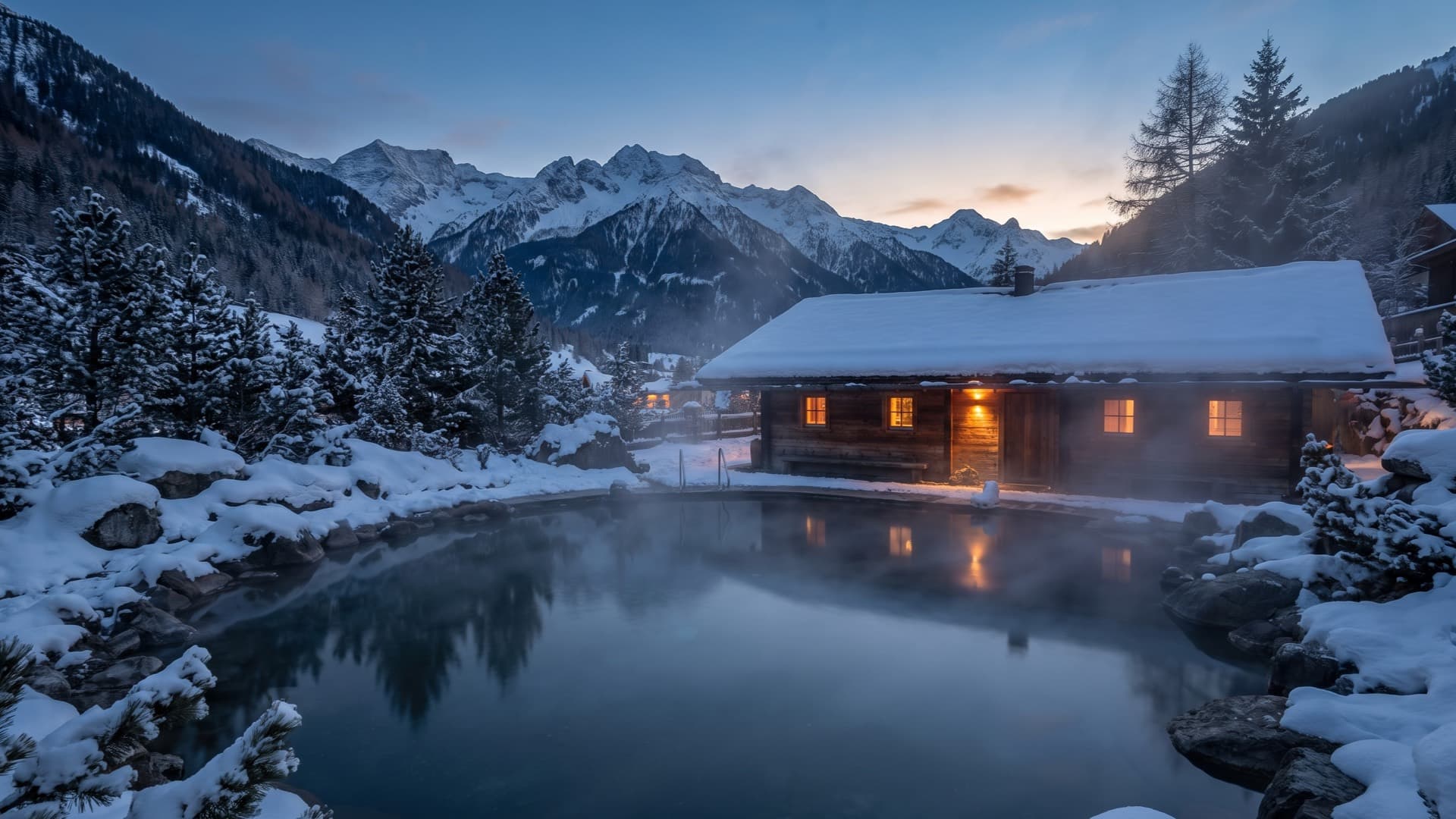
On a first visit, three things tend to surprise people from outside the German-speaking countries. The sauna area is usually entered without a swimsuit, while the pools are not; the rule belongs to the room, and textile-free bathing explains how it works. Parts of a bath can be adults-only: Loipersdorf's Schaffelbad, for one, says so plainly. And the sauna area runs on a published timetable of infusions, the Aufguss; the vocabulary is in sauna types explained. A bathrobe and sandals make the walk between the two worlds easier, and in an Alpine winter they make the walk to the outdoor pool possible. For what that is like, see outdoor pools that stay open in winter.
Styria or the Alps: which should you choose?
Choose eastern Styria if the water and the bath are the holiday. The spas are close together, mostly built since the 1970s around deep, hot wells, and the hotels are attached to the baths. You can try two in a weekend. Choose Gastein if you want the mountains and the old spa town with them, radon water with a long medical tradition, and a bath that is itself a piece of architecture. Choose Bad Ischl for the Salzkammergut lakes and a brine cure in a town that still looks like the emperor's summer.
Whichever you pick, read each bath's own pages for what the water is and what it is said to do. The indications are the operator's, not a prescription; if you have a heart or circulation condition, are pregnant or are considering a radon or medical cure, ask your doctor first.
The list under this article holds all 34 Austrian thermal baths, from the Hundertwasser domes of Blumau and the blown-out oil well at Loipersdorf to the rock bath at Gastein and the brine grotto at Bad Ischl. Start with the depth of the well and the temperature at the source on each page; in Austria they tell you most of the story.