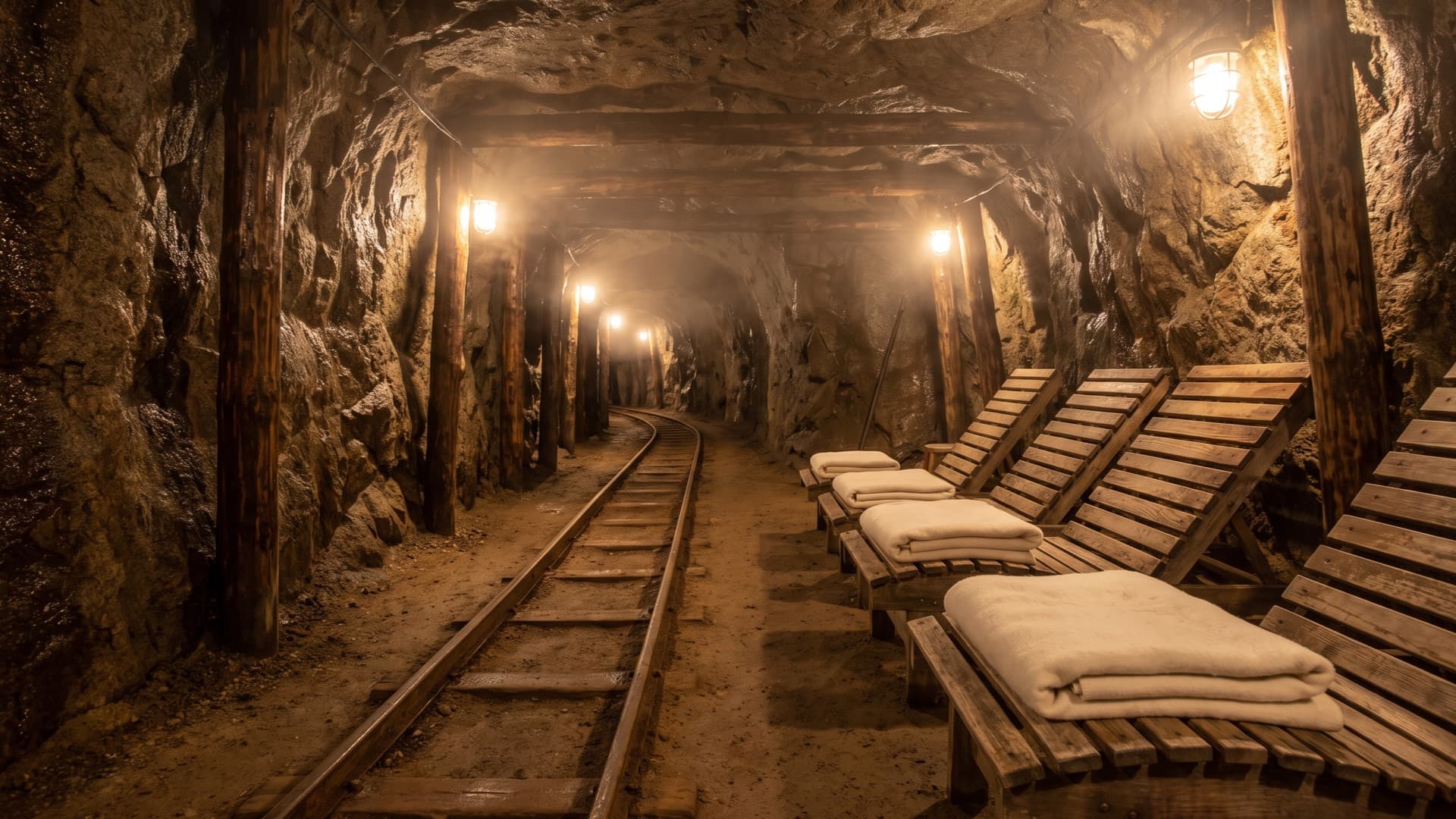
In 1940 miners drove a tunnel into the Radhausberg above the Gastein valley looking for gold. Work stopped in 1943. They had found too little ore to be worth the trouble, and instead rock that was unusually hot and air unusually rich in radon. Doctors began studying the tunnel after the war, and from 1952 it received patients, who ride a small train into the mountain and lie in the warm, saturated air on wooden loungers. It is one of the best-known places in the world where people go on purpose to be near a radioactive gas.
That is the odd thing about radon water. Most thermal waters sell a salt you could, in principle, taste. This one sells a gas you cannot see, smell or taste, which is decaying while you sit in it.
What is radon water?
Water that has picked up radon on its way through the ground. Radon is a noble gas, chemically inert, and it forms continuously in rock as uranium decays: uranium to radium, radium to radon. It is most plentiful where groundwater moves through uranium-bearing granite and gneiss.
The operator of Therme Meran in South Tyrol puts its own water in exactly those terms. Since 1966 it has drawn the water from Vigiljoch, a mountain near Lana about eight kilometres away, and says the granite there enriches the rainwater with radon, fluoride and rare metals before a 1,200-metre tunnel brings it to the baths. What it arrives in is the opposite of a mine: a glass cube designed by the Milan architect Matteo Thun set in a park of palms, according to the South Tyrol tourist board.
Radon is measured not by weight but by activity. One becquerel is one radioactive decay per second, so a water with 1,000 Bq/l has a thousand atoms of radon breaking down in every litre, every second. The commonest isotope, radon-222, has a half-life of 3.8 days. That makes radon water perishable in a way no salt is. The gas also leaves the water as soon as it meets the air, which is why so many radon cures are given in individual tubs filled straight from the spring rather than in a big open pool.
The threshold changes at every border
"Radon water" is a legal term, and the law differs from one country to the next. A 2026 survey of the regulations in central Europe, published in Radiation and Environmental Biophysics, sets them side by side:
| Country | Minimum radon content | Where it is set |
|---|---|---|
| Germany | 666 Bq/l | Spa association standards, adopted by state law |
| Slovakia | 666 Bq/l | Ministry of Health regulation |
| Austria | 370 Bq/l | Each federal state's spa act |
| Czech Republic | 1,500 Bq/l | Act on natural medicinal resources |
| Poland | 74 Bq/l | Geological and Mining Act |
| Hungary | 37 Bq/l | Ministry of Health decree, with medical research required as well |
The German figure looks oddly precise because it converts an older unit, 18 nanocuries per litre. The forty-fold gap between the Czech and the Hungarian minimum is the more useful thing to remember. The word on a brochure tells you that radon is there. It does not tell you how much.
Where do people go for radon water?
15 baths name radon among the dominant constituents of their water, 3 of them in Austria. They run from Alpine towns to a sanatorium facing red rock cliffs in Kyrgyzstan.
Gastein: the valley that made the name
The Gastein valley is the classic case, and its fame is much older than the tunnel. The minnesinger Neidhart von Reuental mentioned its hot springs in a poem around 1230, and by the sixteenth century the Wildbad, as it was called, was a fashionable spa. Its guests, English Wikipedia records, included Schopenhauer, Bismarck and Empress Elisabeth. Schubert wrote his Piano Sonata in D major, D 850, after a holiday there, and it is still nicknamed the "Gasteiner".
Seventeen springs rise at Bad Gastein, at between 40 and 46.4 °C, and deliver around five million litres a day. Felsentherme, in the town itself, is built deep into the rock, and its operator calls it the first public thermal bath in Austria. Down the valley, Bad Hofgastein has received the same water by pipeline since 1830; before that, according to German Wikipedia, it travelled in barrels on horse-drawn carts. Alpentherme Gastein is the bath there now. Our guide to Austria's thermal baths covers the rest of the country.
Sibyllenbad: a seer's name on the Czech border
Sibyllenbad, in the Upper Palatinate a few kilometres from the Czech border, had a slow birth. German Wikipedia records that private investors began planning a spa near Neualbenreuth in 1965 and spent about 16 million marks before the project collapsed. The district bought the site in 1978, the radon-bearing Katharinenquelle was officially recognised as a healing spring in 1991, and the treatment house opened in 1996. The name comes from Sibylla Weis, a seer known as the Sibyl of Prague who is said to have lived to about ninety, a fitting patron for a spa.
Its own medical information is unusually precise. The water in its tubs, it states, carries between 1,600 and 2,000 Bq/l, well over the German minimum, and a course is ten to twelve baths of twenty minutes each at 36 °C.
Eger and Hévíz: radon in Hungary
At Egri Termálfürdő in Eger you can see how differently radon and sulphur water are used in one complex. The operator's pool list gives two radon medicinal pools at 29 °C and sulphurous pools at 32 to 37 °C, cooler water for the radon, not warmer. It also lists a pool sunk three metres below ground, where radon water falls from six outlets set two metres up. Sulphur is the most frequent companion of radon in general: 7 of the 15 name both. The sulphur half of the story is in our piece on sulphur thermal water.
Hévízi Tófürdő is radon water of a different scale. The lake is fed from a cave 38 metres down, its water is completely replaced about every three and a half days, and English Wikipedia calls it the largest swimmable thermal lake in Europe. Red water lilies, introduced in 1898, float on it. Hungarian Wikipedia describes the water as only mildly radon-bearing, which, read against Hungary's 37 Bq/l threshold, is a reminder that "radon" on a Hungarian sign and on a Czech one mean different amounts. More on both towns is in our guide to Hungary's thermal baths.
Teplice, Tskaltubo and Jeti-Ögüz
Lázně Teplice v Čechách calls itself the oldest spa in Central Europe. Beethoven met Goethe in Teplice in 1812 and began his Seventh Symphony there that year; Our guide to the Czech spa towns walks through it.
Further east the history turns Soviet. Tskaltubo in western Georgia was declared a spa resort in 1920, and its slightly radon-bearing water comes out of the ground at 33 to 35 °C, warm enough to bathe in without heating. English Wikipedia describes Spring No. 6 as the largest thermal bath still working there and says it was built in 1950 for Stalin. At Jeti-Ögüz Sanatorium on Lake Issyk-Kul, which its operator says was founded in 1927 on the radon mineral waters of the local deposit, the view is of the red rock formation called Seven Bulls. It treats musculoskeletal, nervous and gynaecological conditions with water and mud.
Jáchymov, in the Czech Ore Mountains, was among the first places in the world to mine uranium, and waste from its uranium works is what the Curies were sent when they found radium. A radon-rich spring was found in the town in 1864, and in 1906 it opened what English Wikipedia calls the world's first radon spa.
Is bathing in radon water safe?
Radon is a known human carcinogen. Indoors it is one of the main causes of lung cancer, which is why the World Health Organization recommends a reference level of 100 Bq per cubic metre of room air and German law uses 300. Every radon cure is therefore a deliberate dose of radiation, and the question is whether the dose is small enough, and the benefit large enough, to justify it.
Germany's Federal Office for Radiation Protection (BfS) answers carefully. In a bath, it says, radon is taken up mainly through the skin, and the lung-cancer risk is clearly lower than in a healing gallery, where you breathe it in. Even a gallery cure, about ten sessions of an hour each, raises that risk only slightly. But the office accepts even that slight increase only where a corresponding medical benefit can be expected, says radon should be used only when medically necessary, and states plainly that radon for wellness purposes is not advised.
The operators publish their own limits too. Sibyllenbad, for example, lists pregnancy and childhood among the reasons not to have a radon bath. If you are considering one, the conversation to have first is with your own doctor, not with the spa.
Does radon therapy work?
For pain in some rheumatic conditions there is evidence, but not much of it. A 2005 meta-analysis in Rheumatology International gathered five randomised controlled trials, 338 patients in total, comparing radon baths or galleries against a control treatment in degenerative spinal disease, rheumatoid arthritis and ankylosing spondylitis. Straight after treatment there was no difference between the groups. Three and six months later, the authors reported less pain in the radon groups. The BfS says simply that the benefits and risks of radon therapy are debated, and German Wikipedia's summary calls the evidence weak, with controlled trials for only a handful of diagnoses.
Five small trials are a thin base for a firm conclusion, and none of them was about healthy people who want a warm bath. Therme Meran, for its part, states that its water is especially suited to chronic respiratory disease and rheumatic joint conditions; that is the operator's claim, and our article on thermal water for joints and back pain looks at the wider evidence.
What is the difference between a healing gallery and a radon bath?
The route the gas takes. In a bath you lie in water from which radon passes through the skin. In a healing gallery you lie in hot, saturated air inside the mountain and breathe it in as well. The Gastein gallery keeps its treatment zones between 37 and 41.5 °C at 75 to 100 per cent humidity, with an annual average of around 44,000 Bq of radon per cubic metre of air, more than a hundred times the German reference level for room air. A visit lasts about ninety minutes, around an hour of it lying down.
The two feel nothing alike. A tub is twenty minutes in water close to body temperature. A gallery is an hour lying in hot, wet air under raw rock, with the condensation running down the walls. The BfS's point about the lungs is why the bath is the gentler of the two.
What a first radon cure looks like
Think of it as a treatment, not a swim. The BfS says radon should be given only where it is medically necessary, and the operators describe it the same way: the course is the unit, not the single bath, as in Sibyllenbad's ten to twelve sessions of twenty minutes. In a big complex such as Eger the radon pools are a few among many, so check which ones they are.
Three questions are worth asking before you book. What is the radon content at the tub, in becquerels per litre, rather than at the spring? Which of your conditions or medicines rule it out, according to the operator's own list? And does your doctor, having heard both answers, think it is worth it?
7 of the 15 hold an official medicinal-water certification, a legal status about composition granted after testing; our guide to certified medicinal water explains what that involves. The baths listed with this article are the ones whose operators name radon in the analysis, from Sibyllenbad's tubs and the Gastein springs to the lake at Hévíz and the sanatorium under the Seven Bulls. Start with the analysis in becquerels, and read it against the threshold of the country it comes from.