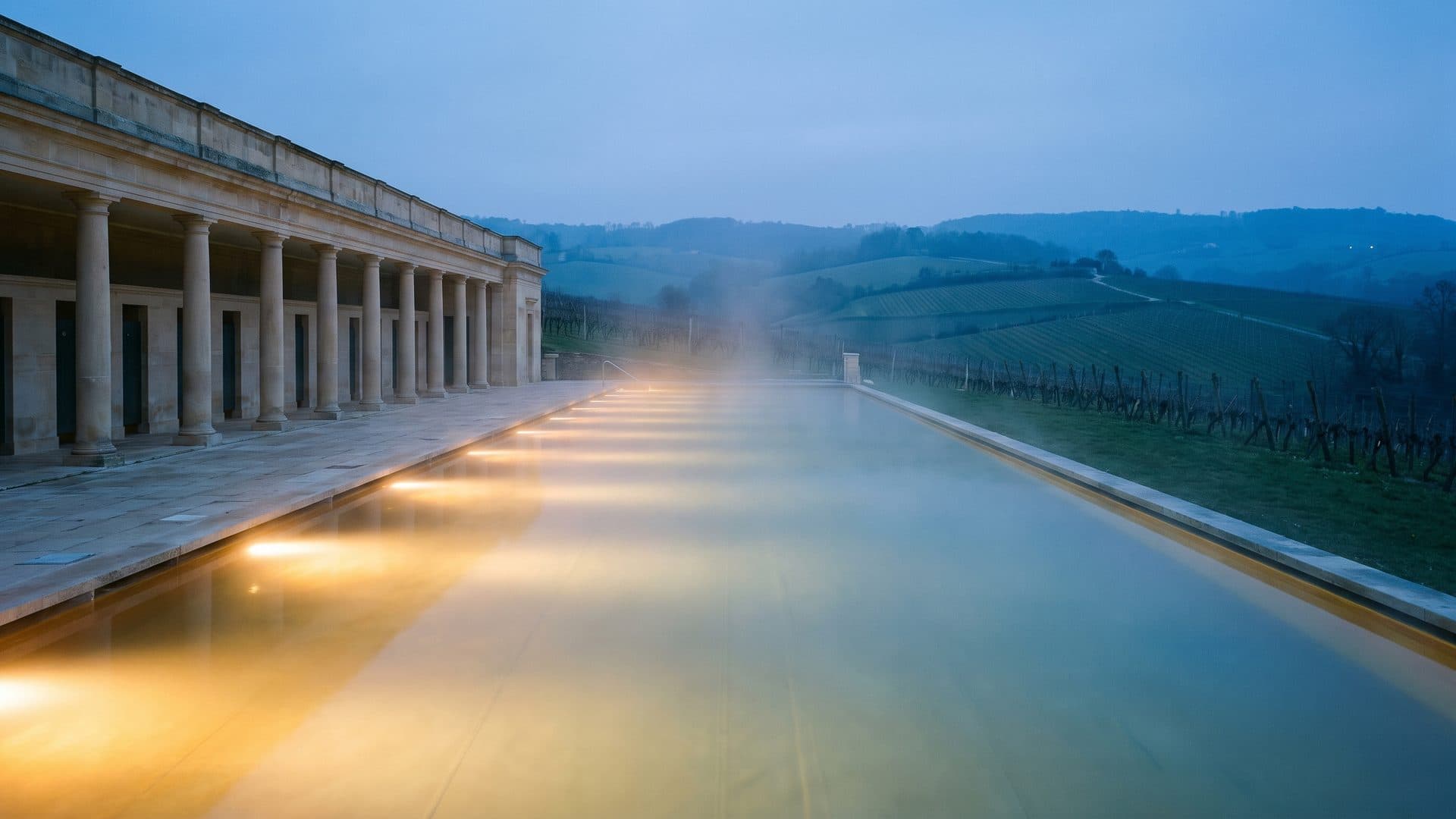
In 1934 a test well for oil was drilled at Oberlaa, on the right bank of the Liesing stream at the southern edge of Vienna. It found no oil. It found a hot sulphur spring instead, and since nobody had any use for one, the borehole was sealed. In 1965 the city commissioned a new search for it. A provisional spa opened in October 1969, and on 27 September 2010 Therme Wien opened beside it, on about 75,000 square metres, roughly 4,000 of them water.
That sequence, a well sunk for one reason and kept for another, turns up more than once in the country around Vienna, and the border runs straight through that country. Within about 100 km of the city there are 22 thermal baths: 9 on the Austrian side and 8 in Hungary, with the rest across the Slovak and Czech borders. The oldest go back to the Romans and the newest opened this century. They are very different days out, and the differences are worth knowing before you choose.
Where are the thermal baths near Vienna?
Start with the one you can reach by underground. The operator of Therme Wien says the U1 runs from Stephansplatz to its last stop, Oberlaa, in about fifteen minutes, step-free. The water comes from the Oberlaa sulphur springs, used for cures since 1969. A second spring was tapped in 2009: it comes up from 900 metres at 47 °C, and the pools are kept at 36 °C, which the operator points out is about the temperature of the body's core. It is a big, modern house, and its operator is plain about what it is not: a Tagestherme, a day bath, with no rooms to sleep in.
Baden, south of the city
Baden is the old answer to the same question. The Romans knew it as Aquae Cetiae and bathed there; the town lies on some fourteen springs that, Wikipedia says, range from about 22 to 36 °C, most of them at the foot of the Calvarienberg. A fire destroyed much of the town in 1812, and it was rebuilt in the Biedermeier style to plans by the architect Joseph Kornhäusel, which is why it is still called the Biedermeier town. By the First World War, about 20,000 people a year came from Vienna to take the waters, twice the number who lived there.
The guest list is the one people quote. In June 1791 Mozart's wife Constanze was staying in the spa town while pregnant with their sixth child, and Mozart wrote the Ave verum corpus there for his friend Anton Stoll, music director of the parish church; the autograph is dated 17 June. Beethoven stayed in Baden several times, and one of his lodgings, at Rathausgasse 10, is now a museum. In 2021 the town became one of the eleven Great Spa Towns of Europe on the UNESCO World Heritage List, alongside Bath, Baden-Baden and Karlovy Vary.
You can bathe in that water in two very different buildings. Römertherme Baden fills its outdoor pool with the town's sulphur healing water and sits under what its operator calls the largest freestanding glass roof in Europe. Thermalstrandbad Baden is the other Baden: a lido, opened on 24 July 1926 after a building season of barely three months, to designs by the builder Alois Bohn. Its sand beach is the largest artificial one in Austria, and for decades the story went that the sand had been shipped up from the Adriatic. In 1951 it was admitted that it came from a bay of the Danube near Melk. The two sulphur pools were heated in 1926 with water from the Marienquelle. In 1927 the transatlantic flyers Clarence Chamberlin and Charles Levine paid a visit; in 1938 the bath was declared for "Aryans" only and Jewish guests were turned away. It is a listed monument now.
A spring that stays at 19 °C
Further south, at the foot of the hills near Wiener Neustadt, Fischauer Thermalbad is the place that changes what you think "thermal" means. Its operator gives the water as a constant 19 °C, summer and winter. It rises from deep under the Fischau foothills at about 25,000 litres a minute and, without pumps, replaces itself in the pools up to four times a day. There are two historic pools, once one for men and one for women, from the era of the Austro-Hungarian monarchy, when nobility and the new middle class came out from Vienna for the summer. It is a place to swim, not to lie still, and the cold is part of the point.
Over the borders
East, in Hungary, Büki Gyógy és Élményfürdő has an origin story that rhymes with Oberlaa's. In the autumn of 1957 a survey looking for oil near Bük found hot water instead. According to the Hungarian tourist board, 58 °C water burst out with great force from about 1,200 metres. The town built a bath in 1962; the water was later classified as medicinal, a year-round house followed in 1972, and in 1979 Bük became Hungary's tenth officially designated healing place.
North, just over the Czech border, Lázně Hodonín is a spa of a different kind. Its water is an iodine brine that the operator describes as the remnant of an ancient sea, pumped from sandstone about two kilometres down, with roughly 50 milligrams of iodide in every litre, several times as much, the operator says, as Dead Sea water. The town's hospital began trial baths with it in 1953; a pipeline from the boreholes came in 1971, and the spa itself opened on 1 July 1979. The brine is too strong to sit in as it comes: for individual baths the operator dilutes it half and half with warm water. Further east, Sirnaté lázně Ostrožská Nová Ves opened on 29 June 1903 on a cold spring carrying dissolved hydrogen sulphide, beside the flooded gravel pits that locals call the Slovácko Sea.
How warm is the water, really?
Around Vienna the temperatures on a bath's website rarely mean the same thing twice. At Oberlaa the spring is 47 °C and the pools 36 °C. At Bük the water reaches the surface at 58 °C. At Fischau it is 19 °C all year, the spring's own temperature. Hodonín's brine is hot underground and diluted before anyone gets in. None of these is wrong; they are measurements of different things.
The useful figure is the one for the basin you will sit in, and for that a range beats a single number. 13 of the baths around Vienna publish one. Baden's Thermalstrandbad shows why: with two 50-metre swimming pools and two sulphur pools, one house holds both a swim and a soak, and they are not kept at the same temperature. When a bath advertises a high temperature, check whether it belongs to the borehole or to a pool. Nobody bathes for an hour at 47 °C.
What does "medicinal water" mean on each side of the border?
13 of the 22 baths use water that a state recognises as medicinal. Each recognition is real, and they are not the same thing.
In Austria it belongs to each federal state. In Lower Austria, which surrounds Vienna, a spring becomes a Heilvorkommen only by decision of the state government, after expert opinions on its hygiene and geology, and only if the owner shows enough yield, suitable chemical or physical properties and a scientifically recognised healing effect without altering the water. The decision is published in the state's law gazette. A town that uses such a source on the spot and has the facilities for it can then be recognised as a Kurort; Baden is one.
In Hungary the word on the sign is gyógyvíz, healing water. A bath may use it only with a licence from the Budapest government office, issued on the opinion of the national public health centre, which also states how the water may be used, outside or inside the body, and under what conditions. It is the gyógy- at the start of so many Hungarian bath names.
In Czechia a přírodní léčivý zdroj, a natural healing source, is certified by the Ministry of Health under the spa act, 164/2001 Sb., and protected by decree; Hodonín's wells are among them. Slovakia uses the parallel term prírodný liečivý zdroj. So a bath an hour east of Vienna and one an hour north of it can both be called medicinal, and the two claims rest on different laws, different authorities and different tests. Our piece on certified medicinal water goes further into what each label requires.
Day Therme or spa house: which kind of place should you choose?
The baths here fall into two families, and the difference matters more than the distance.
The first is the day Therme: you arrive, rent a locker or a cabin, stay the afternoon and go home. Therme Wien, the Römertherme and the big pools at Bük are of this kind. Expect the sauna area to be a world of its own. At Oberlaa it covers 3,000 square metres over two floors, with a women's sauna, a men's sauna and a mixed one, a garden of old trees, and a 34 °C outdoor pool for the sauna guests.
The second is the spa house, the Czech lázně, the Hungarian healing place in its older sense, where the water is part of a stay with a doctor and a treatment plan. At Ostrožská Nová Ves the operator's offers are stays of a weekend up to a week, built around its sulphur springs; Wikipedia names skin conditions such as psoriasis and eczema, and arthritis, as what most patients come for. Hodonín sits between the two: alongside its spa houses it opened a Denní lázně, a day spa, in 2015, and it runs an indoor pool open to the public. If you want an afternoon, check that a place sells a day ticket at all before you drive. If you want the cure, a day bath is no substitute.
What to know before the first visit
The sauna is where first-timers are caught out. At Therme Wien the saunas admit guests from fourteen, swimwear is not allowed, and you sit covered by a towel; if you would rather keep your costume on, the Laconium in the main bath area takes swimwear. Bük's Sauna World is textile-free too. If the custom is new to you, our guide to textile-free bathing explains how it works without embarrassment, and this guide to sauna types decodes the names on the doors.
In the pools the rules are more relaxed than people expect. Therme Wien allows burkinis as long as they are close-fitting and made of a fabric that does not soak up water. Towels and bathrobes can be rented; sandals of your own make the walk to the sauna pleasanter.
Sulphur water smells of hydrogen sulphide, the smell of eggs, and you will notice it before you see the pool. Therme Wien's medical department states that a sulphur bath should last at most twenty minutes, and it lists the conditions for which warm immersion is advised against, among them severe heart disease, poorly controlled high blood pressure, pregnancy, fresh wounds and acute fever. Those are the operator's statements, not medical advice. If you have a heart or circulation condition, are pregnant or are unsure, ask your doctor before you go. For more on the water itself, see our piece on sulphur thermal water.
The list under this article holds the 22 thermal baths in the same box around Vienna, from the oil well that became Therme Wien at the end of the U1 to Bük and Hodonín across the borders. Pick a direction, decide if you are after a swim, a soak or a cure, and look up that bath's own pool list for the day you plan to go.