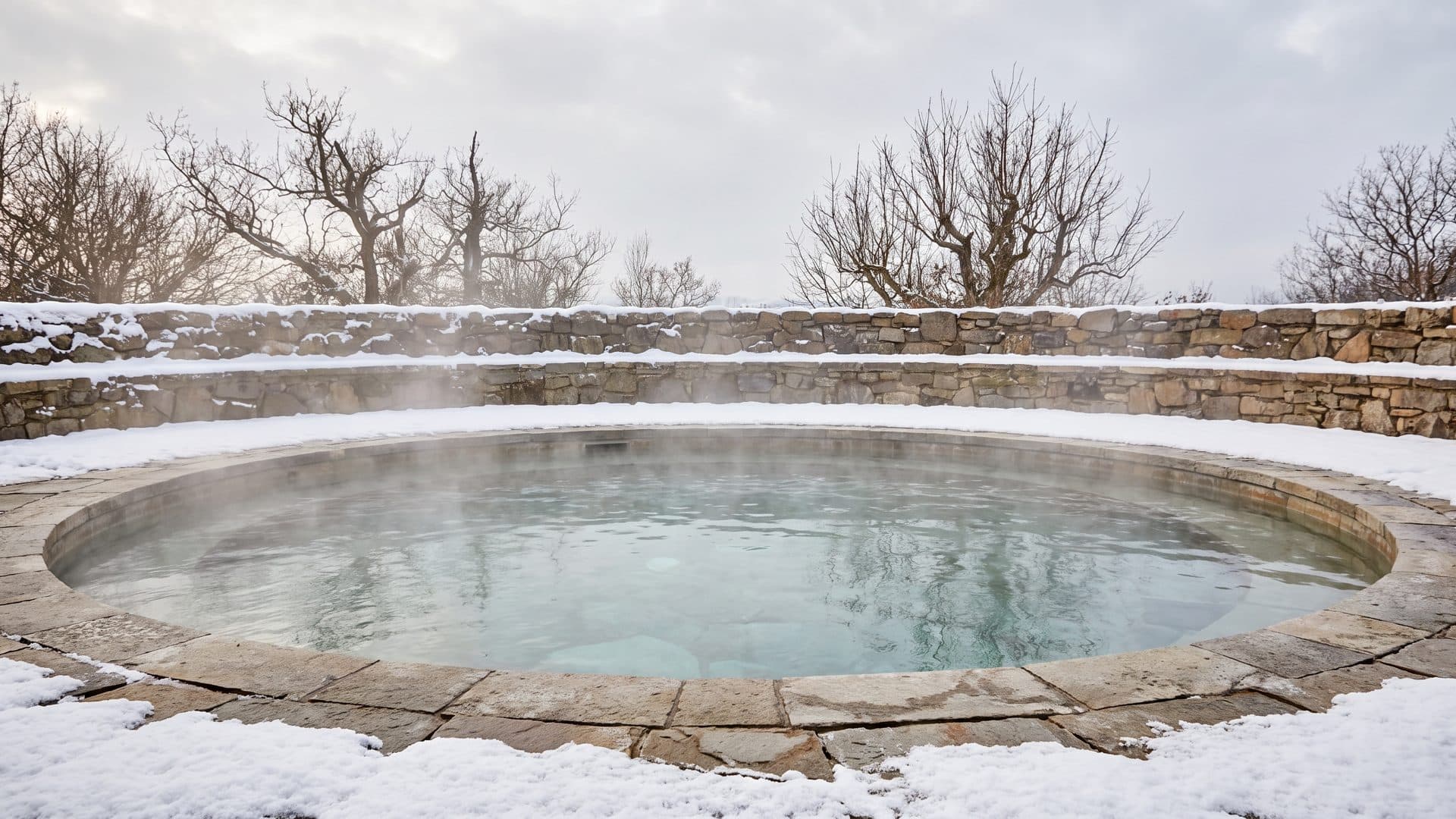
At Pamukkale, on the plateau above the white travertine terraces, there is a pool where you swim over broken columns. Wikipedia's account of the ancient city of Hierapolis says the Antique Pool was shaped by an earthquake in the seventh century AD, when a marble portico in the Ionic order fell into the spring. The pieces are still there. Visitors to Pamukkale Antik Havuz, sold as Cleopatra's Pool, float above fluted marble lying on the bottom, in warm spring water under an open sky.
It is an extreme example of something ordinary. "Open-air bathing" is one phrase for several quite different places: a council pool with a lawn, a Hungarian town's mineral-water basins, a hot stream running into a river in Tuscany, a heated tub built into a sea wall in Iceland. 551 baths state that they have an outdoor pool, and 394 of them are thermal baths. Knowing which kind you are driving to is most of the planning.
What is the difference between a lido and a Freibad?
Less than the words suggest. Both are public outdoor pools, usually of ordinary water, built for swimming and lying on the grass.
Lido is Italian for beach. The English word probably came from the press: in 1930 George Lansbury, the Labour government's First Commissioner of Works, had the bathing place on the Serpentine in Hyde Park revamped, and the newspapers called it "Lansbury's Lido". What made it news, Wikipedia notes, was that Lansbury allowed mixed bathing. The decade that followed was the lido's golden age in Britain: local councils built 169 of them. Hundreds have closed since, many after cheap holidays abroad arrived, and 127 remain open in England, several reopened by local campaigns after years of being shut.
The German Freibad grew out of the river. The first places that look like a modern open-air pool, the German Wikipedia explains, were the Flussbadeanstalten: a pontoon anchored in a river, with a platform and a sunken basin, and changing cabins lined up in a row to keep curious eyes off the bathers. Swimming freely in a river could still be punished in the middle of the nineteenth century. One of the first Freibäder in northern Germany was opened in Lübeck in 1799 by a swimming teacher, Anton Kreidemann.
Kaifu-Bad in Hamburg shows how a city bath grew from that. It began as an indoor bath, the Stadtbad Hohe Weide, built between 1893 and 1895 to designs by Franz Andreas Meyer, then chief engineer of the city's building authority. The open-air pool came in 1938, designed by the architect Konstanty Gutschow. The bath stands on the Isebek canal, on a bank once called Kaiser-Friedrich-Ufer, which Hamburg shortened to Kaifu. The whole complex is a listed monument. Its operator, the municipal company Bäderland, calls it the oldest bath in Hamburg, more than 120 years old, and says it could just as well be called a cult bath.
What you get today is the classic German Freibad in good order: a 50-metre pool for swimming, one of the city's few 10-metre diving towers with platforms at five, three and one metres, a large lawn, a children's water playground and a boules court. Since 2015 there has also been a brine pool, the Kaifu-Sole, 17 by 11 metres with six per cent salt. The detail worth knowing before a visit is that a second outdoor pool runs all year, while the Freibad itself keeps a summer season. A Freibad is a summer word; a pool inside it may not be.
What is a thermal strand?
In Hungary you do not go to the pool, you go to the strand. The Hungarian Wikipedia gives the word two meanings: the strip of land where water meets shore, and, in everyday speech, the outdoor bathing grounds with pools that towns build for their residents. It suggests the second sense came from German, where the word drifted the same way. A termálstrand is the version filled with water from a thermal well: basins on a lawn, the medicinal pool next to the swimming pool, the town bath at its busiest in summer.
Tiszafüredi Termál Strand és Gyógyfürdő, in the town of Tiszafüred on the Great Plain, is a clear example of the form. Its operator lists an outdoor medicinal pool for sitting and an outdoor strand pool for swimming, and describes the water as an alkaline hydrogencarbonate medicinal water. It states that the water suits chronic musculoskeletal and rheumatological complaints, worn spinal discs and some chronic gynaecological conditions, and that physiotherapy built beside the bath complements it. Those are the operator's claims; if you are going for treatment rather than a day out, ask your doctor first. The mixture is the point of a strand: treatment and a summer day out share one lawn.
The word on the gate can mislead in the other direction too. Fischauer Thermalbad, south of Vienna, is called a thermal bath, and its spring rises all year at a constant 19 °C, the operator says, from deep under the Fischau foothills. It flows at about 25,000 litres a minute and replaces the water in the two historic pools up to four times a day with no pumps at all. It is a superb summer bath and a cold one, and the name does not tell you that. Why the word on the sign proves so little is the subject of our piece on what Therme means.
Can you bathe in a wild hot spring?
Sometimes. Bagni di Petriolo sits on the north bank of the river Farma, about 30 kilometres south of Siena, and its springs come out of the ground at about 43 °C along a stretch of the riverbank. According to the Italian Wikipedia the water is sulphurous, with a measurable dose of hydrogen sulphide, so you will smell it before you see it, and it can be used both freely and in the equipped establishments nearby. The first masonry bathhouse went up at the start of the fifteenth century, built to look like a fortress, and in the Renaissance it drew the Medici and the Gonzaga: Ludovico III Gonzaga, Marquis of Mantua, and his brother Alessandro, who suffered from rickets. Pope Pius II came too. For the chemistry of that smell, see our piece on sulphur water.
Terme Libere, Acqua Borra, near Monteaperti in the clay hills of the Crete Senesi, is the same idea with a longer memory. The municipality of Castelnuovo Berardenga describes an underground reservoir of very hot water that has been depositing its dissolved limestone for so long that it built a travertine hill. Clay objects found at the spring were thrown into the water to honour the nymphs who were believed to guard it. In 1647 a physician from Siena, Leandro Terucci, wrote a treatise on the water that mixed observation with folk belief. In the late nineteenth and early twentieth centuries the travertine hill itself was quarried for building stone; one wall survives, now part of a farmhouse. Locals, the municipality says, bathed there for centuries for their skin, joints and muscles.
Wild springs ask more of you than a bath does: nobody at a ticket desk tells you how hot the water is, and the place is more fragile than any pool. At Pamukkale, Wikipedia notes, UNESCO and the local authorities regulate the flow of water and periodically close sections of the terraces to protect them, and the only bathing is in the designated pools.
The sea pool
Iceland has turned the wild hot tub into public architecture. Guðlaug sits in the rock breakwater on Langisandur, the town beach of Akranes, about 49 kilometres from central Reykjavík. The town council explains how it came about: when the memorial fund of Jón Gunnlaugsson, a boat owner, and Guðlaug Gunnlaugsdóttir was wound up in 2014, its board gave 14 million krónur towards a hot pool by the beach. Basalt Architects designed it, and the work was finished in December 2018.
It is built on three levels. At the top is a viewing deck shaped like the bow of a boat, next to the spectator stand. In the middle is the hot pool. Below it, at beach level, is a cooler pool fed by the overflow, where sea swimmers adjust before or after the bay. Steps link the levels, the shore and the sand, so the bay and the warm water are a few steps apart. Entry is free, and the council says it is open all year. In Iceland as a whole, the number of baths that state they have an outdoor pool is 13.
How warm is the water in an outdoor pool?
It ranges further than the photographs suggest. Of the 551 baths with an outdoor pool, 299 publish a water temperature. At 40 °C or more the count is 30, and that is water for sitting, not swimming. At the other end, the count at 30 °C or less is 34, the range of Fischau's 19 °C spring: wonderful on a hot afternoon and quickly cold once the sun goes. One caution in reading these numbers: an operator usually publishes the temperature of its main pool, and the main pool is not always the one outside.
In winter the temperature decides whether the visit works at all, and year-round outdoor bathing has its own guide: outdoor thermal pools that stay open in winter.
Choosing between them
If you want to swim lengths, a lido or a Freibad is built for it. Expect a 50-metre pool, as at Kaifu, a diving tower if you are lucky, and grass to lie on. The water is usually ordinary pool water at pool temperature, and the season is summer unless the operator names a pool that runs longer.
If you want warm water and a lawn, look for a thermal strand. Read the pool list: a strand typically separates a cooler pool for swimming from a hotter medicinal pool for sitting, and the medicinal pool may come with posted guidance on how long to stay in. Hungary's strands are the archetype, and our guide to Hungary's thermal baths covers the country in more detail.
If you want slides, that is a water park, and its outdoor area is a separate question from whether the park is open; our water parks guide goes into it.
If you want the spring itself, Petriolo and Acqua Borra are the type: water straight from the ground, a riverbank or a travertine hill around it, and whatever facilities the place happens to have. Petriolo shows that the two can sit side by side, with free bathing on the riverbank and equipped spa establishments, some with hotels, using the same springs.
Whichever you choose, two questions are worth asking the operator. The first is what the water is: tap, river, sea, a spring at 19 °C or one at 43 °C. The second is which outdoor pools run in the week you plan to go. Hot water outdoors is still hot water, and any guidance a bath posts about time in its hottest pools applies under the sky too. If you have a heart or circulation condition, are pregnant or are unsure, ask your doctor before going; healing claims on a bath's website are the operator's statements, not medical advice.
The list under this article holds the 551 baths that state they have an outdoor pool, from Guðlaug on its sea wall to the columns under the water at Pamukkale. Open one, look at what its water is and how warm the operator says it runs, and pick the afternoon that suits you.