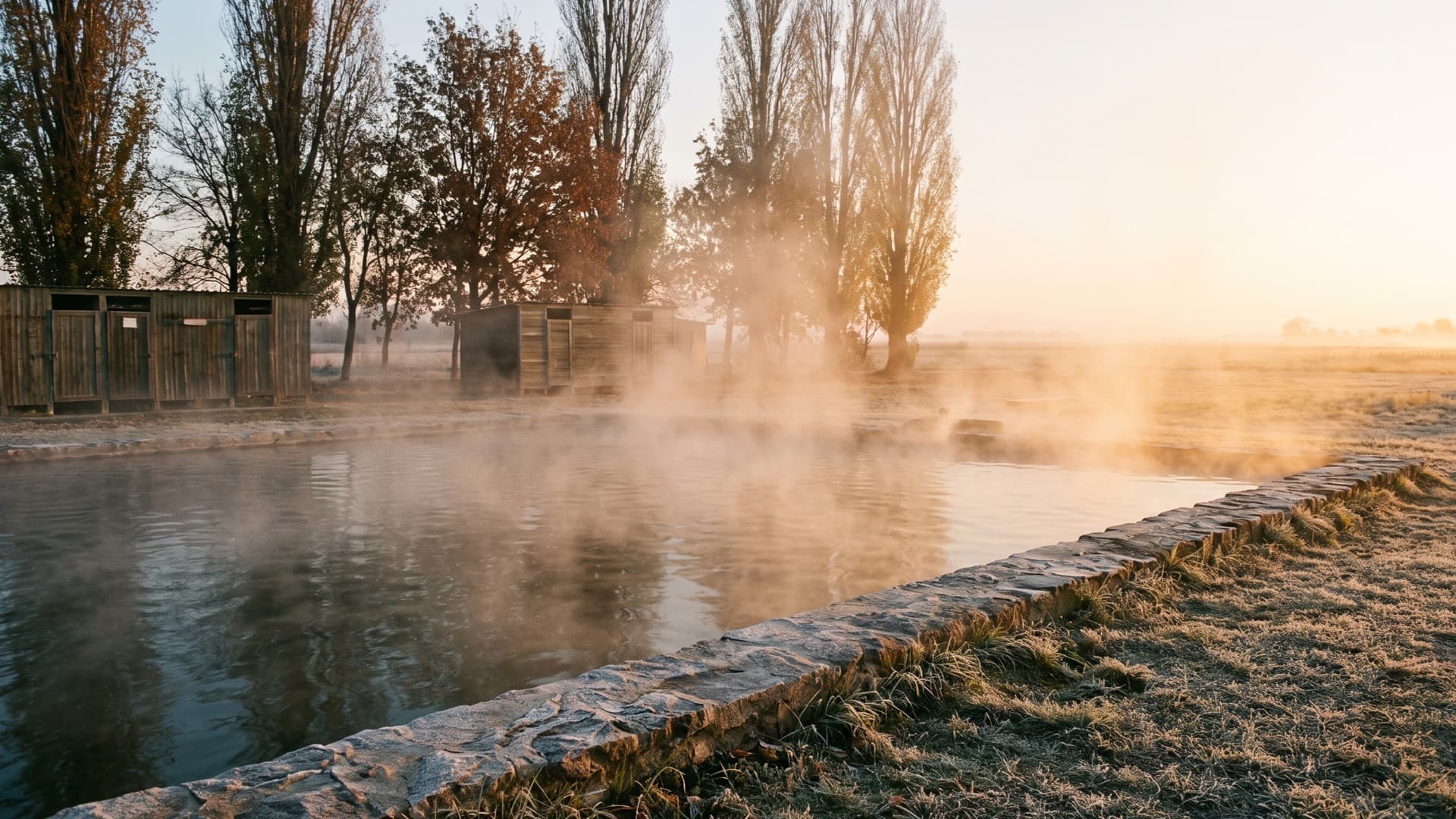
On 25 October 1925 a crew drilling for hydrocarbons at Hajdúszoboszló, on the Great Plain east of the Tisza, hit water instead. It came up from 1,091 metres at 73 °C and spilled into the ditches around the rig. According to the history published by Hungarospa Hajdúszoboszló, people bathed in it and washed their laundry in it, and noticed that cuts healed faster. The first bath building, known as the mud bath, opened on 26 July 1927. The spa still calls the geologist Ferenc Pávai-Vajna, who chose the drilling site, the father of its thermal water.
Change the town and the decade and the story repeats. Bük in 1957, Zalakaros in 1962: someone went looking for oil and found a bath. The country also has springs people bathed in long before anyone drilled, and those are the stranger places.
Why does Hungary have so much thermal water?
Because the country sits in the Pannonian Basin, where the crust is thin. GeoERA, a joint project of Europe's geological surveys, puts it at roughly 25 km, with the temperature rising about 0.05 °C per metre of depth, close to double the usual rate for continental crust. The basin was once a shallow sea that left kilometres of porous sediment full of water. An oil company drilling the plain was always going to find hot water. Of the 47 Hungarian baths that publish the temperature of their water as it comes out of the ground, 32 report 50 °C or more.
Bük: the drill that came up warm
In the autumn of 1957 an oil survey near Bük, in the far west close to the Austrian border, brought up warm water. According to Hungarian Wikipedia, the municipality built a bath at the well in 1962, the water was declared medicinal in 1965, and a covered bath followed in 1972 so that people could take a cure in winter. The water, a calcium-magnesium-hydrogencarbonate type, comes from 1,282 metres. Today it is Büki Gyógy és Élményfürdő.
Zalakaros: almost boiling
Five years later, at Zalakaros south-west of Lake Balaton, a rig drilling for oil struck water of almost 96 °C. The medicinal bath opened in 1965. Hungarian Wikipedia notes iodine, bromine, sulphur and fluoride in it together. Water that hot is cooled long before it reaches a pool at Zalakaros Gyógy- és Élményfürdő.
What do gyógyfürdő and gyógyvíz mean?
You will see both words on gates, and they are legal terms. Hungarian law on natural healing factors (Government Decree 509/2023) defines gyógyvíz, medicinal water, as a natural mineral water with a proven healing effect. The proof is medical, assessed by the health authority's specialist panel. A gyógyfürdő, medicinal bath, is a facility that gives bath treatment using medicinal water, mud, gas or another natural healing factor.
Termál says something else: that the water is warm, conventionally above about 30 °C. A termálfürdő needs no certificate, and a cool spring can still be gyógyvíz. 70% of the 138 Hungarian thermal baths in the list use certified medicinal water. Bük waited eight years from the find to the certificate, Hajdúszoboszló thirteen, which gives you an idea of how much testing goes into one. For how certification works elsewhere in Europe, see certified medicinal water.
The springs that were there before the drills
Hévíz: a lake you swim in
The name means hot water. A document of 1328 already mentions the place, in the Hosszúsár marsh of Zala county, and calls the nearby settlement Köszvényes falu, Gout Village. In 1769 Ferenc Szláby, the county's chief physician, made the first scientific analysis of the water. Count György Festetics, founder of the Georgikon farming school in nearby Keszthely, put a bath house on rafts on the lake in the late eighteenth century, and in 1905 the Festetics family leased the bath business to Vencel Reischl, a brewer from Keszthely, for 35 years.
The red lilies came in 1898, brought by Sándor Lovassy, a teacher at the Keszthely agricultural academy, according to Hungarian Wikipedia. The lake itself nearly went in the 1980s: bauxite mining in the Bakony hills pumped out so much karst water that the flow fell to less than half. On 20 April 1989 the Council of Ministers ordered the mine closed to save the lake, and the flow came back.
Hévízi Tófürdő is the lake bath, and the operator describes the lake as about 250 metres across, fed from a crater 40 metres deep with a source cave at the bottom that two divers, István Plózer and Lajos Csávosi, found on 10 February 1975. The water renews itself in about three days, and Wikipedia calls it the largest thermal lake in Europe you can swim in. In summer, the operator says, it reaches 35–38 °C, and in winter it never drops below 22 °C, which is when the mist lies on it.
A first visit is unlike any pool. The lake is between 2 and 38 metres deep and you cannot stand, so most people float, and the operator rents swim rings against a deposit. Snorkels and any diving gear are forbidden. The operator recommends 20–30 minutes in the water at a time with at least half an hour's rest between, and no more than an hour to an hour and a half a day. It does not recommend the lake for children under 12, and it advises leaving jewellery, silver above all, in the locker, because the water can discolour it. Since 18 March 2025 the central bath building on the lake has been closed to guests, after an expert report found its structure not safe enough.
Harkány: the sulphur you can see
In the far south, near the Croatian border, the spring at Harkányi Gyógy- és Strandfürdő turned up in 1823, while the marsh was being drained. English Wikipedia credits a well digger, János Pogány, who noticed that the warm water helped his bad leg. The operator says the Batthyány family, who owned the land, built the first bath houses the following year. The water rises from 50–70 metres at an average of 62 °C, and what the operator singles out in it is carbonyl sulphide, about 12 mg per litre, identified in a chemical analysis in the 1860s. There is elemental sulphur in it too, in particles fine enough that you notice them only when light falls on the pool from the side.
The operator states that the water is used for degenerative diseases of the joints and spine, the hips, knees and ankles above all, and for chronic gynaecological inflammation. The bath sits in a park of 13.5 hectares. For more on this water, see sulphur thermal water.
Miskolctapolca: pools inside the hill
On the edge of Miskolc, in the north-east, the water comes out of a limestone hill. The operator of Barlangfürdő, the Cave Bath, traces the place back to a Benedictine abbey and to a wooden bath house first described in 1743. In 1941 a new bath palace opened, built on 212 red pine piles because the ground was so muddy, with a glass roof over its domed hall that could originally be opened and closed at the press of a button. The first bathing section inside the cave followed in 1959. Passages explored from the 1980s became bathing halls between 1998 and 2005.
What you get today is a walk through rock. One hall has a domed ceiling with a star map projected on it. In another you cross the pool on a bridge. The water is warm rather than hot: the operator gives 30 °C in the main hall and 32 °C in the cave halls, so this is a place for drifting through the passages, not for sitting still for an hour.
Gyula: a bath in a castle park
Gyula, on the Romanian border, had bathing long before it had thermal water. The operator of Gyulai Várfürdő cites a document of 1518 that made the parish priest responsible for the town's bath, and the Ottoman traveller Evliya Çelebi counted eleven baths in Gyula. The thermal story starts in 1942, when the Almásy family founded a company to build a spa in the castle garden and lent money for the drilling. The drilling began in 1943 and stalled again and again. Thermal water finally reached the surface on 17 September 1958, and the Várfürdő opened on 1 May 1959.
The castle still stands next to it, and the count's riding hall of 1833 became the bath's winter hall in the 1960s. The operator adds that when the 50-metre pool opened in 1972, Gyula became the first town in Hungary where swimming lessons were compulsory for every child.
Egerszalók: a white hill
Just outside Eger, hot water at 65–68 °C rises from about 410 metres and runs down a hillside. As it cools it can hold less of what it dissolved underground, and the excess settles out as limestone. Hungarian Wikipedia gives the deposit as 120 square metres and compares it with Pamukkale in Turkey and Yellowstone. Locally it is the sódomb, the salt hill. The water was classified as medicinal in 1992, and until 2002 a small pool beside the hill was free to anyone.
The old way of bathing has survived at the foot of the hill. Nosztalgia fürdő is a small strand with three pools, at 36–37, 37–38 and 38–39 °C according to the regional tourism listing, and a buffet that sells lángos and sausage.
What is a strand, and how is it different from a spa resort?
The word fürdő covers two kinds of place. One is the town strand, the strandfürdő: outdoor basins in a park with lawns, busiest in summer, with a buffet somewhere near the water. Hungarian Wikipedia names strands, with markets and fairs, as where lángos, the fried dough with sour cream and cheese, is mainly sold. 42 Hungarian thermal baths still have strand in their name. Gyula's riverside bathing place got its permit in 1930, and Hajdúszoboszló built a 50 by 51.5 metre concrete pool in 1928, a year after its first bath house.
The other kind is the resort: an indoor pool hall, a sauna area, a treatment wing and often a hotel. Most of the places in this article are both at once. Hajdúszoboszló added a water park in 2000; Gyula, a family water park in 2013.
How to choose
Choose a strand for a long summer day outdoors, and the certified medicinal pools when the water itself is the point. For a place like nothing else, go to Hévíz or the cave at Miskolctapolca. In winter, ask which outdoor pools are actually filled; winter outdoor bathing covers what to check.
What should you know before a first visit?
The house rules at Hévíz show what a medicinal bath expects. Showering first is compulsory. Children under three wear closed swim nappies, and no one under 12 may use the sauna area. The ticket covers a set bathing time, so ask at the desk how long yours runs.
Medicinal water is not neutral. The Hévíz operator lists heart and circulatory disease, high blood pressure, fever, infection and pregnancy as reasons not to use its facilities, and asks every guest to get a doctor's opinion before bathing. Whatever a bath states its water does, those are the operator's statements; if you have a condition or take medication, ask your doctor first.
And Budapest?
The capital is a world apart, with 18 thermal baths of its own. It has its own guide: Budapest's thermal baths.
The list under this article holds all 138 Hungarian thermal baths, from the lake at Hévíz and the cave at Miskolctapolca to the strands of the Great Plain towns. If a medicinal cure is what you are after, open a bath's page and look for the certified-water mark; if it is a summer day you want, look for strand in the name.