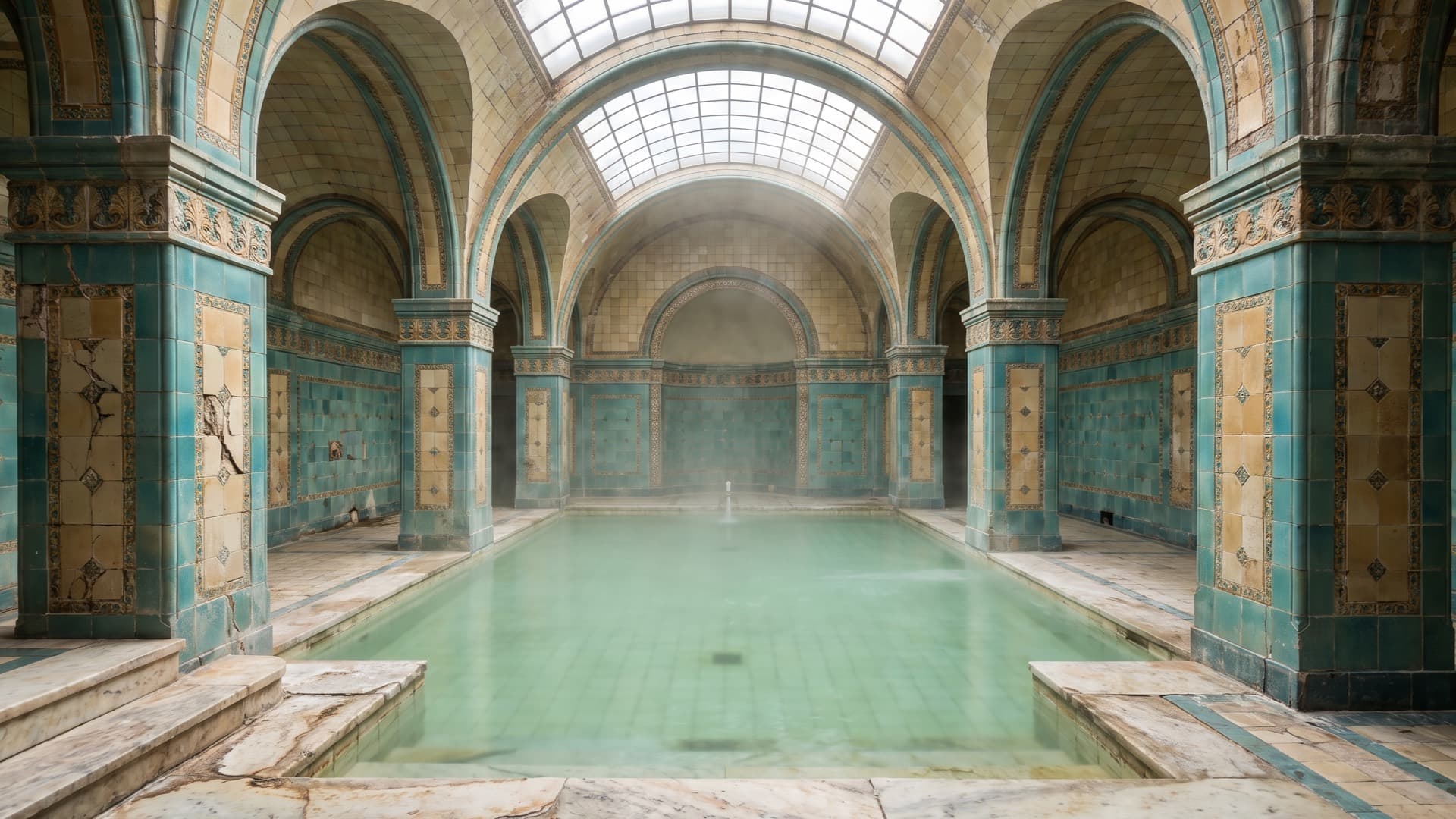
In 1663 the Ottoman traveller Evliya Çelebi wrote that whenever someone in Buda died, the family had water brought in barrels from one particular bath and washed the body with it, and that this was counted among the city's good customs. The bath was the one now called Veli Bej. Its operator, the Hospitaller Order of Saint John of God, quotes him in its history, together with a traveller named Melchior Besolt who in 1584 went there with his companions after supper and remembered the water for its quality and the bath for its many ornamental fountains.
The water still comes up in the same place, in the narrow strip between the Danube and the steep Buda hillside. Budapest lies on a geological fault that separates those hills from the plain, and more than a hundred thermal springs reach the surface along it. In 1934 the city was officially ranked a "City of Spas". The Romans already used the springs at Aquincum, in today's Óbuda. Within the city limits there are 18 places to bathe today, and the buildings over the water come from almost every century since the Ottomans.
Why does Budapest have so many thermal baths?
Because of where the hills stop. The fault under the city runs along the foot of the Buda side, and the old baths line up on it: Rudas and Gellért below Gellért Hill, Szent Lukács and Veli Bej further north, among the springs known as Felhévíz.
On the Pest side, the best-known bath stands on a drilled well. The mining engineer Vilmos Zsigmondy concluded that an artesian well in City Park was the likeliest to succeed, and on 4 March 1868 the Pest city assembly agreed to pay for it. According to the operator of Széchenyi, the drilling began in November 1868 and was finished in January 1878, close to where Heroes' Square now stands. A second well followed in 1938, more than 1,250 metres deep, and it brings water up at 77 °C. That is far too hot to bathe in. The same bath runs its pools at 38 °C.
The Ottoman baths
The Ottomans held Buda from 1541 to 1686, and the baths they built are the oldest in the city still in use. Three of them go back to Sokollu Mustafa Pasha, governor of Buda from 1566 to 1578.
Rudas, at the Buda end of the Elisabeth Bridge, keeps the essential plan of a hammam: an octagonal pool under a dome, with smaller pools around it. Its operator describes four corner pools in the domed hall that are still there today. The Turks called it the bath of the green pillars. The pillar is gone, but green stones built into the walls can still be seen. Above one of the springs, Wikipedia notes, a stone with a Hungarian inscription names the pasha who built it, and locals have long believed that spring makes you younger.
The building kept changing after the Ottomans left. On 1 December 1696 Leopold I handed the area to the city. In 1916 a bottling plant opened in a former inn next door and sold the water of the Hungária spring as mineral water, and as a carbonated version called Harmatvíz, until 2005. In 1924 a drinking hall for the same spring went up in the park between the bath and the bridge. One detail from the operator's history shows how customs come and go: women's days in the steam bath were dropped in 1936 for lack of interest, and brought back after the renovation of 2004.
Veli Bej is the quieter one. A chronogram, a verse whose letters add up to a date, once fixed its completion to 1574–75, and its operator calls it the most finely built bath of the Ottoman period. In 1806 the building was given to the Order with a stone at the entrance dedicating it "to the sick who have no one to care for them". In the 1840s József Hild built a grand spa complex around it. The 20th century was less kind: in 1974 a "restoration" raised the floor, cut new windows and covered the original walls in marble.
The Order got the complex back in 2000. When the marble came off, archaeologists from the Budapest History Museum found the original floor, painted plaster, the old water pipes and the well that fed the bath, along with a medieval cemetery and millstones. Today the Ottoman walls stand inside a cloister roofed with glass, the bath has no outdoor pool, and the bathing happens under the domes.
Király, built in the same years, was unusual in having no spring of its own: the Ottomans piped its water underground from the springs further north. Its operator states that it is closed for an indefinite period and gives no reopening date.
The chemist and the spring
Veli Bej's history also has a scientist in it. When a patron bought the bath complex around it in 1802 and cleared the ruins, workers uncovered a spring bubbling with carbon dioxide that the Turks had kept as something sacred. In 1804, on the order of the Lieutenancy Council, a medical commission that included the botanist and chemist Pál Kitaibel examined the spring and determined its chemical composition, and its reputation as a healing water spread from there.
Palaces, a hall of thanks and a people's bath
Széchenyi opened on 13 June 1913, to designs by Győző Czigler, in City Park. Its open-air pools followed in 1927, and in 1963 the outdoor changing rooms were made usable in winter, which is why, as its operator says, the outdoor pools have run all year since then.
Gellért, built from 1912 to 1918 at the foot of Gellért Hill, is the Art Nouveau counterpart: a main hall with a gallery under a glass roof, mosaic tiles inside, and from 1927 an outdoor pool that makes artificial waves. Wikipedia records that an Ottoman bath stood on the site before it, known as the "muddy" bath, and that a bomb at the end of the Second World War destroyed the Zsolnay pyrogranite façade of the women's bath. Its operator states that the bath has been closed since 1 October 2025 and expects to reopen in 2028.
Szent Lukács has a more personal history. Its operator traces it to the Knights of Saint John, who cared for the sick here in the 12th century; under the Ottomans the force of the springs drove mills for gunpowder and grain. After Fülöp Palotay bought the bath from the treasury in 1884, it became a spa hotel, and guests who had been cured put up marble tablets of thanks on the courtyard wall. The bath was also a meeting place for writers, actors and musicians, and a memorial plaque carries almost thirty names; six have reliefs, among them the composer Zoltán Kodály and the writers István Örkény and Géza Ottlik. The drinking hall dates from 1937.
Dandár tells a different story. In 1928 the city's public works council decided to build people's baths, places where the hygienically necessary bath could be had cheaply, and Dandár, opened in 1930, was the first. It is a brick building, Art Deco with a touch of north German brick Expressionism, and, according to Hungarian Wikipedia, the plan at the time was to bring its thermal water by tanker from the Széchenyi well. Since 1978 it has had its own.
Which Budapest baths have certified medicinal water?
9 of the 18 hold Hungary's official medicinal-water certification. You will see it in their names, which often include gyógyfürdő, "medicinal bath". It is a legal status granted after the water has been tested, not a marketing word; the guide to certified medicinal water explains what it covers.
The name can also tell a story the water no longer does. Pesterzsébet in the south of the city is officially the "iodine-salt" medicinal bath. Its operator describes two wells: a thermal well with calcium, magnesium, sodium, chloride, sulphate and hydrogencarbonate, and the iodine-salt well that gave the bath its name, a very hard sodium-chloride water with bromide, iodide and a good deal of iron. That second well, the operator notes, is currently not in operation. Its medicinal pool is available on a doctor's prescription only.
Dagály, on the Pest bank north of the Árpád Bridge, opened in 1948 as a lido and has counted as a medicinal bath only since 1970, when thermal water from Széchenyi was piped across to it. In the Kádár years, Hungarian Wikipedia says, people in the district called it the Néplavór, the "people's washbasin", for the summer crowds. Its outdoor medicinal pools sit in the mid-30s while the long pools are cooler, for swimming.
The indications these baths list for their water are the operators' statements. What they mean for you is a question for your doctor, and if you have a heart or circulation condition or are pregnant, ask before you go.
Should you choose a domed bath or an open-air lido?
They are different afternoons. The Ottoman baths are interiors: dim halls where the light falls through small openings in the cupola, and the visit is a slow move between pools of different heat. The spa palaces have both, halls inside and big pools outside. The lidos are built for the open air and for summer.
Temperature is the practical test. 8 of the 18 publish a pool temperature, and 5 of those run a pool at 38 °C or more. Lukács gives 40 °C for its hottest. That is water for sitting in; Lukács keeps cooler pools for swimming.
For a lido with a past, go north to Csillaghegy. Its operator cites the geologist József Szabó, who in 1858 described a brick-walled pool fed by the springs, whose water drove a mill. The bath itself was founded in 1919, with sunbathing terraces stepped up the hillside, and the operator says it built the first wave pool here in 1925. A later pool, built for international races, saw the Olympic champion Johnny Weissmuller, later the film Tarzan, swim against István Bárány. That pool sank because of a structural fault and had to be pulled down; the swimming hall stands in its place. More on summer bathing is in the guide to open-air bathing, and on the cold months in the winter one.
What should you know before your first visit?
Most of the city's best-known baths are run by one company, Budapest Spas, and its bathing guide sets the same few rules for all of them. Slippers are compulsory. You shower before you get into a pool, and use the foot bath on the way in. A swimming cap is required in the swimming pool. No food or drink in the water. Anyone with a fever or a stomach or respiratory illness may not come in.
The rule that surprises families is about age: Széchenyi, Rudas, Lukács and Dandár do not admit children under 14 at all. At the company's other baths, children under 14 may use the medicinal pools only on a doctor's prescription. If you are travelling with children, a lido is the easier choice.
Access is worth checking before you go too. Rudas states plainly that the bath is currently not accessible to people with disabilities. If you need step-free access, ask the bath directly; the guide to step-free thermal baths lists what to ask.
Finally, check that your bath is open. 3 of the 18 are currently marked as temporarily closed, Gellért and Király among them, as their operators state. For the domes, go to Rudas or Veli Bej; for the palace, Széchenyi.
The list under this article holds all 18, from the green-stoned hall at Rudas and the glass cloister of Veli Bej to the terraces of Csillaghegy and the people's bath on Dandár utca. Pick one by the water you want, check its status that week, and take your slippers.