On 14 June 1977 a covered leisure pool opened in Pfäffikon, on the southern shore of Lake Zurich, with a wave machine indoors and two warm pools outside. Alpamare was the first place of its kind in Switzerland, and according to German Wikipedia it soon became the largest covered water park in Europe. The English Wikipedia article on water parks puts it at the head of its short list of early indoor parks, ahead of Center Parcs' Aqua Mundo in the Netherlands (1980) and the Tikibad at Duinrell (1984).
Some of the 1977 park is still there. The wave pool is still indoors, and these days it runs in darkness, with a staged thunderstorm of lightning, thunder and rain over the water. Outside, the iodine-brine pool from opening year is kept at 36 °C, and it has a rule that surprises families: no children under sixteen. The slides came later, from 1986 on. One of them, Balla Balla, is 261 metres long, and Wikipedia's article calls it the longest pure body slide in Europe. The operator settles for calling Alpamare the largest water park in Switzerland.
That mix of a wave pool, warm water outdoors and a slide tower added over the years is the European water park in miniature. The word covers a lot. It can mean a resort with a hotel and forty slides. It can just as well mean a town's covered pool that has grown slides, a warm lagoon and a sauna. Of the 414 water parks listed here, 186 are in Germany, and most of those are the second kind: the Erlebnisbad or Freizeitbad, "adventure pool" or "leisure pool", open all year because it is also where the town swims.
What kinds of water park are there in Europe?
Roughly three, and they are different days out. The first is the covered tropical hall, built in the north for the northern climate, where the weather outside is part of what the place sells against. The second is the open-air summer park of the Mediterranean coasts, slides and lawns around a wave pool, which closes when the season does. The third is the thermal water park, mostly in Central Europe, where a hot well was there first and the slides came afterwards.
The lines blur. A tropical hall often has an outdoor area for summer. A summer park may have a covered corner. Plenty of German Therme have a slide tower, which is why the word on the sign deserves a closer look before you trust it. Still, the three kinds are a good first question to ask of any park, because the answer tells you when to go and what you will actually do there.
The tropical halls
One of them is in a building that was never meant for bathing. In 2000 the company CargoLifter commissioned a hangar at Halbe, about fifty kilometres south of Berlin, for the CL160, a cargo airship. The company went bankrupt in 2002 and the airship was never built. The Malaysian group Tanjong bought the empty hall in 2003, and on 19 December 2004 it opened as Tropical Islands: 360 metres long, 210 wide, 107 high, the air held at 26 °C. Inside are a beach, a lagoon, a rainforest that Wikipedia puts at about 50,000 plants, and a Bali Lagoon. A sauna complex came in 2007, and outside, for the summer, there is Amazonia, more than 35,000 square metres with two large pools. Since 2018 the resort has belonged to the Spanish group Parques Reunidos.
Rulantica, at Rust, about thirty kilometres north of Freiburg, approaches the same idea through a story. Europa-Park, the Mack family's theme park next door, opened it on 28 November 2019 and set it on an invented island in the Norwegian Sea; the name blends Rust and Atlantic. More than 32,600 square metres are under a roof that Wikipedia describes as one of the largest wooden roof structures in Europe. The mascot is Snorri, a blue cephalopod with six limbs, and the outdoor area, Svalgurok, has nine slides of its own. Hyggedal, a sauna and quiet area, followed in October 2020.
In Denmark the name to know is Lalandia. The first opened at Rødby in 1988. Lalandia Billund followed on 24 April 2009, and its Aquadome of 10,000 square metres is, in the words of its Wikipedia article, Scandinavia's largest water park.
Which is the biggest water park in Europe?
It depends on who is measuring, and on what. Several parks have held the title, each by its own yardstick. Alpamare was the largest covered park in Europe in the years after 1977. When Aquaboulevard opened in the 15th arrondissement of Paris in April 1989, French Wikipedia records, it was described as the largest water park in Europe. Jacques Chirac, then mayor of Paris, inaugurated it that May, and the building still houses a full-size whale from the former Cousteau ocean park. Its water park covers about 7,000 square metres, which is small beside what came later.
English Wikipedia calls Tropical Islands the largest indoor water park in the world. Polish Wikipedia calls Suntago Wodny Świat, which opened at Wręcza, about fifty kilometres from Warsaw, on 20 February 2020, the largest covered water park in Poland and in Europe. Both can be right at once. A hall can be the biggest single building, while another park counts more slides, more pool surface or more people it can take in a day. So when a park says it is the biggest, read the next line to find out what it is counting, and pick the measure you care about. For a family that is probably the number of things a seven-year-old can do. For a couple it is probably the size of the sauna area.
The summer parks
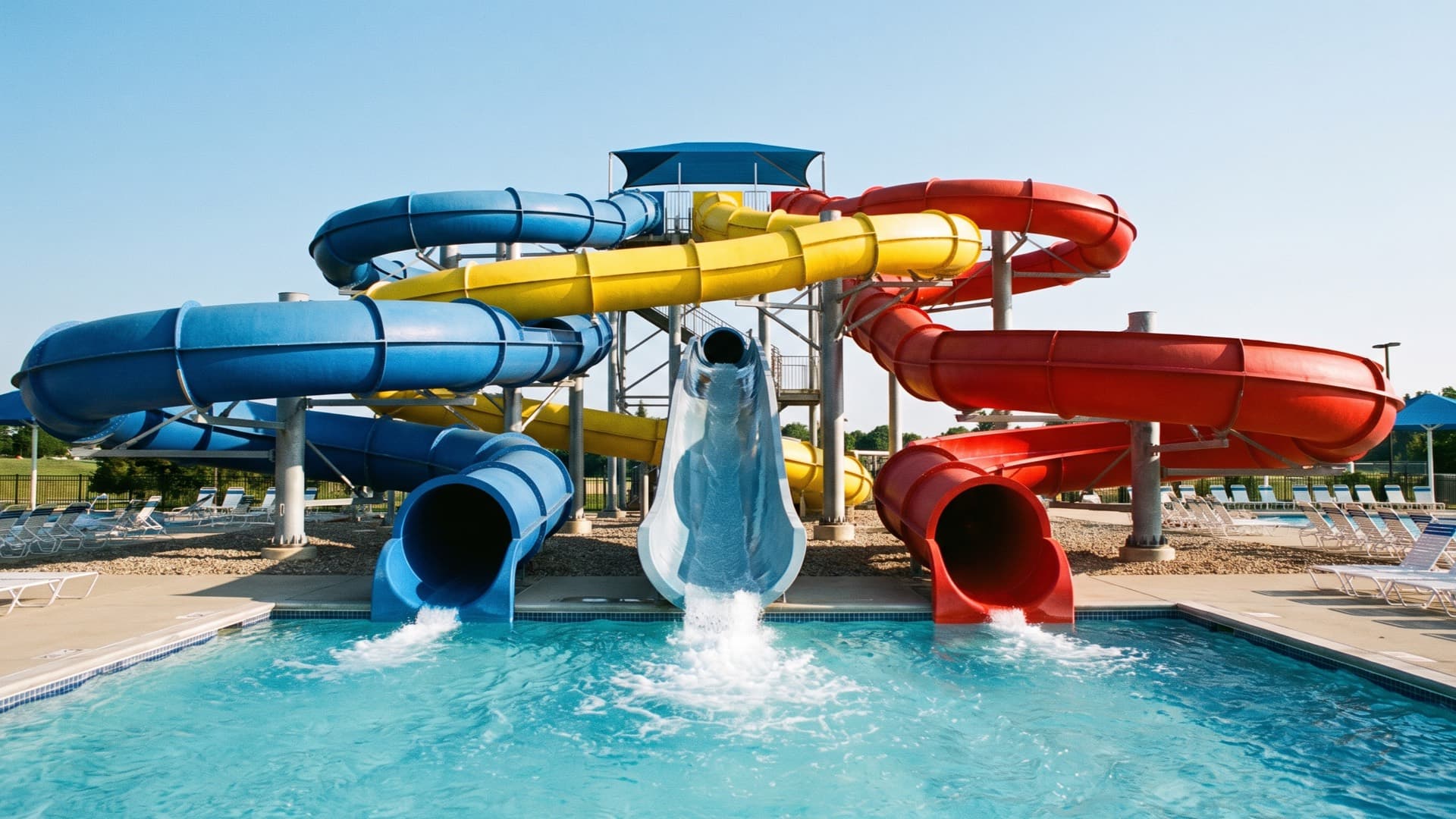
The open-air park is the picture most people have of a water park: a hillside of slides, a lazy river, a wave pool, sun loungers in rows. In southern Europe the season makes it possible and also sets its limits. Istralandia, near the road from Novigrad to Nova Vas in Istria, opened on 21 June 2014 as Croatia's first water park. Its wave pool of about 2,500 square metres is, according to Wikipedia, the largest in the Mediterranean, and its season runs from late May to late September.
Many of the big southern parks belong to chains, and the chains have a history of their own. The Aqualand name began in 1983 at Cap d'Agde, on the French Mediterranean, and spread along the French coast, to Spain and to Portugal. Since 1999 it has belonged to the Spanish group Aspro-Ocio, which bought Alpamare the same year, so the Swiss indoor pioneer and a string of Mediterranean slide parks have shared an owner ever since.
Which water parks use thermal water?
Most water parks run on treated, heated mains water and say nothing more about it, because there is nothing more to say. 35 publish a spring or well temperature of 30 °C or more, and in Central Europe several of them grew up around hot water that turned up by accident. At Hajdúszoboszló, in eastern Hungary, the thermal spring was struck on 26 October 1925 during drilling for oil and gas. The complex built on it, Hungarospa Hajdúszoboszló, now includes Aqua-Palace, an indoor water park of 15,000 square metres and fifteen pools that the operator connects directly to its medical spa and its open-air baths, each with its own ticket. The water is certified as medicinal, and 8 water parks here sit on water with that status, which is explained in our piece on certified medicinal water. That is a statement about the spring, not a reason to go down a slide for your health. If you have a medical reason to bathe in it, ask your doctor first.
In the Tatras, AquaCity Poprad says its thermal pool water rises from a depth of 1,300 metres. Further west, at Liptovský Mikuláš, Tatralandia opened on 5 July 2003 on the northern shore of the Liptovská Mara reservoir. Slovak Wikipedia says it is fed by a borehole more than 2,500 metres deep, with water at 60.7 °C, and that four of its fourteen pools are open only in summer. Its covered hall, Tropical Paradise, keeps the air at 30 °C all year.
Suntago drills deep too. Most of its pools are filled from a well 1,720 metres deep, and Polish Wikipedia says the same water heats the building and cuts its electricity use by two-thirds. There are some 300 palms in the slide zone and another 400 in the quiet zone, most of them from Florida, Costa Rica and Malaysia.
Thermal does not mean hot in every pool. A park with a hot well still runs most of its water at swimming temperature, because nobody wants to come off a slide into a hot bath. What the well buys is a few warm basins beside the slides, and in winter that is the difference between a park you shiver in and one you can sit in. If the warm outdoor water is the part you are after, our piece on outdoor pools that stay open in winter goes into what to check.
Tropical hall, summer park or thermal park: which should you choose?
Start with the month. A covered hall is the safe choice from October to April, and 67 water parks here say they are open all year. Many more probably are and just do not say so. A summer park is the better day in July, when the halls are hot and full. Between the two, a thermal park with outdoor basins is the one place where a cold, clear day can be the best day, but find out which of its pools actually run that month. Tatralandia is a good example: four of its pools are summer-only.
Then look at who is going. The zones that matter to adults often have an age limit. At Suntago the palm-garden spa and the Saunaria are marked 16+. At Alpamare the warm iodine-brine pool is closed to under-sixteens. If brine is new to you, our guide to brine baths explains what it is. A family with a twelve-year-old and a family with two teenagers can have very different days in the same building.
A first visit
Find out what one ticket covers. At Hungarospa the medical spa, the open-air baths and Aqua-Palace each have their own ticket, and many tropical halls sell the sauna area separately. In German-speaking countries that sauna area is usually textile-free, which catches first-time visitors from elsewhere out; the custom is explained here, and our guide to sauna types covers the names on the doors.
Read a park's claims about itself as you would read a menu: with interest, and with a question ready. "Largest" and "first" usually come with a measure attached if you look for it. "Thermal" should come with a spring or a well and a depth. And a missing detail on a listing, a wave pool or an outdoor area, means nobody has written it down yet, not that the park does not have it. Ask the operator.
The list under this article starts with Alpamare and the airship hangar and runs through all 414 water parks, from Rulantica's island to town leisure pools with one slide and a warm lagoon. Open the ones near your route to see which of them say they open all year, and which have a hot well underneath.