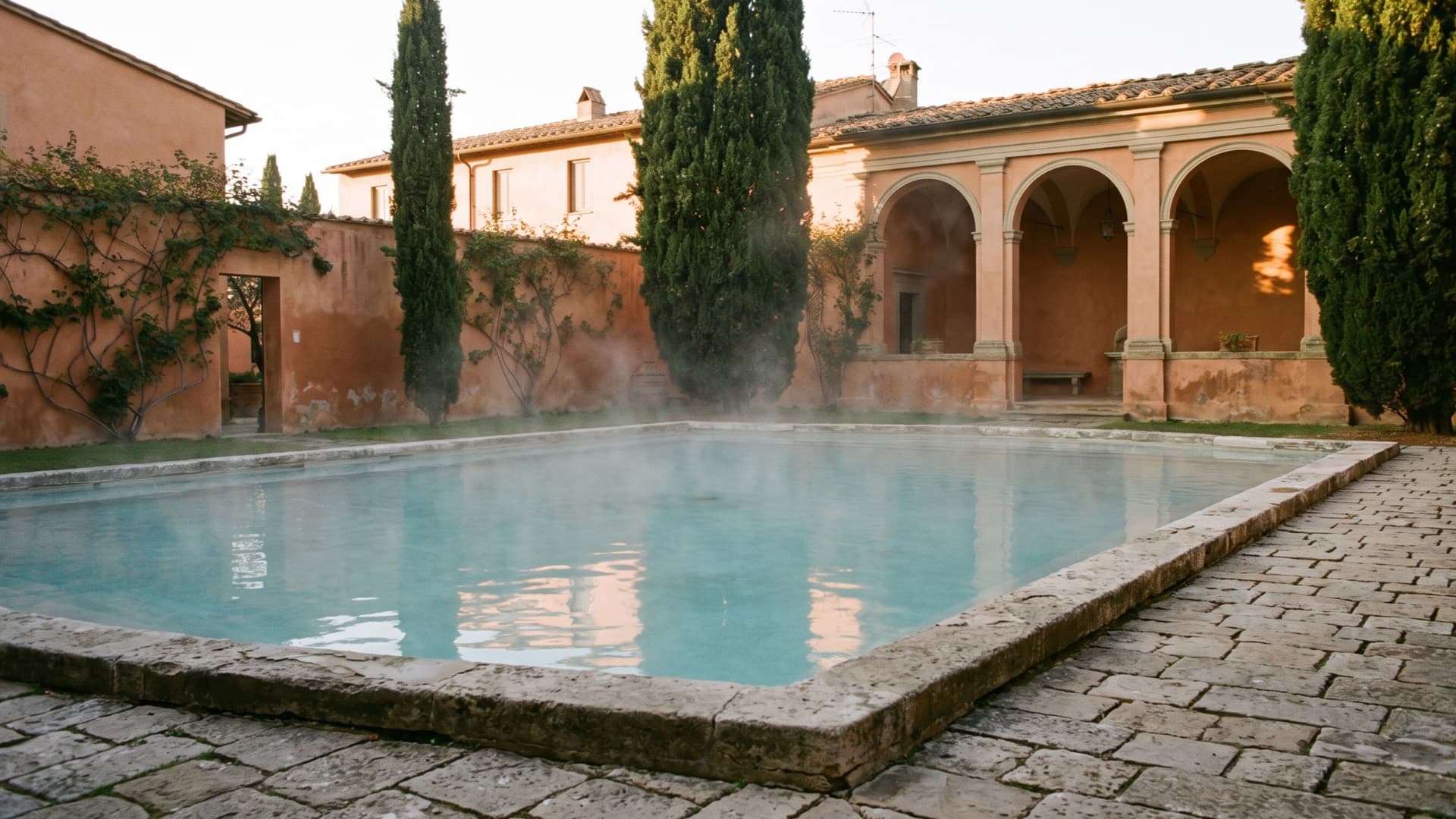
In Canto XIV of the Inferno, Dante needs a picture of a hot stream for his readers, and he picks a real one: the Bullicame, just outside Viterbo. "Quale del Bulicame esce ruscello", as the stream that flows out of the Bullicame, he writes, and the comparison assumes his readers knew the place. Many would have known it from the road. In 990 Sigeric, the new archbishop of Canterbury, rode home from Rome along the Via Francigena after collecting his pallium, and the itinerary kept by his party lists the spring, under the name of Saint Valentine, as the sixth stop out of the city.
The water still comes up at about 58 °C, smelling of sulphur. At Terme dei Papi, which takes its water only from the Bullicame spring, it is led into a monumental pool of some 2,000 square metres through stone mouths that point towards the centre. The operator keeps the pool open in summer and winter, and says that in winter the park around it disappears in the water's own steam. In the rock beside it is a natural cave that fills with vapour at 45–48 °C and 100 per cent humidity, which the operator calls a natural Turkish bath.
That is one Italian bath. Another is a cave lake under a Tuscan hill. Another is a walled spa on a river south of Siena where a pope and the Gonzaga of Mantua came to bathe. What they share is a word on the sign, and in Italy that word has a legal meaning.
What does "terme" mean in Italy?
It means medicine, at least on paper. Law 323 of 24 October 2000, which reorganised the Italian thermal sector, defines acque termali as natural mineral waters used for therapy, and cure termali as treatments with those waters, or products made from them, with recognised therapeutic efficacy, given in licensed establishments. It then reserves a list of words for exactly that: terme, termale, acqua termale, fango termale, idrotermale, idrominerale, thermae and, notably, spa, glossed in the law as salus per aquam.
Two things follow. Temperature is not part of the definition, so a cold sulphur spring can feed a terme while a heated pool of tap water cannot be one. And the classic Italian terme is closer to a clinic with a pool than to a leisure bath. The treatment rooms, with their mud packs, inhalations and hydro-massage tubs, are the core of the place. The thermal pool is often what serves everyone who is not on a cure. If the German word is more familiar to you, what Therme means explains why it promises much less.
Can you take a thermal cure on the Italian health service?
Yes, and in many spa towns that is the economic backbone. Terme di Comano, in Trentino, lays out the steps plainly. The first is a conversation with your family doctor, who, if a cure is appropriate, writes the prescription on the regional form, the ricetta rossa. It has to name a condition on the ministerial list of 15 December 1994, with its code, and the type of cycle: baths, inhalations, insufflations. You then book, and you begin with an admission visit with the spa's own doctor, who sets the programme. The health service covers one cycle per calendar year, twelve consecutive sessions. Comano works mainly with skin, and lists psoriasis and atopic dermatitis among the conditions it treats, alongside respiratory complaints.
Bring your identity card, your health card and the prescription; Comano adds that recent reports, such as blood tests or a dermatologist's letter, help the spa doctor. A child accompanied by one parent needs the written consent of both. Terme di Trescore, near Bergamo, notes that a second covered cycle in the same year is only open to certain categories of disabled patients, for their disabling condition. Visitors from abroad can book the same treatments privately. What any operator says its water does is the operator's statement, and whether a cure suits you is a question for your doctor.
Where to go: six places with a story
A cave that Verdi loved
In the spring of 1849 workers quarrying lime on the land of Domenico Giusti at Monsummano, in the province of Pistoia, moved a large boulder and found a deep cavity with water in it. Domenico was the father of the poet Giuseppe Giusti, and the cave carries the family name. It runs for about 300 metres through three zones, each warmer than the last, traditionally called Paradise, Purgatory and Hell. The air reaches 34 °C at its warmest, with humidity close to 100 per cent, and in the stretch called Limbo a small lake stays at 36 °C all year. Garibaldi stayed in 1867 and the Hungarian exile Lajos Kossuth in 1871. Giuseppe Verdi called the place the eighth wonder of the world, and that line is the one Grotta Giusti Terme still lives on.
The walled bath on the Farma
About 30 kilometres south of Siena, sulphur water at around 43 °C rises along a stretch of the river Farma. Early in the fifteenth century someone built a bath house there that looks like a castle: a wall about six metres high with three towers and gates, enclosing roughly a hectare, a church on the upper floor and a loggia with pools below, near the water. Pope Pius II came, and so did the Gonzaga of Mantua, among them Ludovico III and his brother Alessandro, who suffered from rickets. Today Bagni di Petriolo is looked after by the heritage association Italia Nostra, which began restoring it in 2015 and opens it for guided visits. To get into the water, go to Terme di Petriolo, which draws its spring on the bank of the Farma at 43 °C and applies its mud at 47 °C.
Saturn's spring
Down in the south of Tuscany, the operator of Terme di Saturnia tells the founding myth with a straight face: Saturn, tired of humans forever at war, threw a thunderbolt at the earth and hot sulphur water burst out of the crater. The Romans called the waters Aquae Sanctae. The prosaic version is better. The water falls as rain on the slopes of Monte Amiata, spends about forty years underground, and comes up at 37.5 °C, which the operator points out is the temperature of the human body. One house rule surprises people: to enter the thermal park you bring, or rent, a white towel and a white bathrobe.
Under Lake Garda
Sirmione's spring was known in the sixteenth century, but it rises from about 19 metres below the surface of the lake, and nobody could use it until it was piped in the late nineteenth century, according to Wikipedia. The spa that uses it says the water fell as rain on Monte Baldo, above 800 metres, travelled for some twenty years and comes up at about 69 °C, sulphurous and salso-bromo-iodic. At Aquaria, its thermal garden, the outdoor pool is kept at 34 °C in summer and 36 °C in winter, a freshwater infinity pool runs out towards the lake, and the operator recommends twenty minutes in the thermal water at a time. Entry is booked online, and a swimming cap and towel come with the ticket.
Leonardo's baths above Bormio
At the top of the Valtellina, nine springs rise between 1,280 and 1,421 metres on the dolomite slopes of Monte Reit at roughly 37–43 °C. In a letter of 535 or 536, Cassiodorus mentions the aquae Burmiae; in 1493 Leonardo da Vinci stayed and wrote in the Codex Atlanticus that at "Burmi" there are baths. The revival came in the 1830s with Carlo Donegani's new road over the Stelvio, which passes right above Bagni Vecchi, and in 1836 the Grand Hotel of Bagni Nuovi opened. At the old baths a sweat grotto is cut into the rock, with the San Martino spring rising inside it, and a large outdoor pool looks across the basin of Bormio towards the Stelvio National Park, where, the national tourist board says, ibex are often seen.
A spring in the middle of town
At Acqui Terme in Piedmont, the Roman Aquae Statiellae, the spring does not hide in a park. La Bollente rises in the town centre at up to 75 °C, under a small pavilion designed in 1870 by Giovanni Ceruti, and the remains of the Roman aqueduct still stand by the river Bormida. The water is used for cures at Stabilimento Curativo Nuove Terme.
Tuscany alone has 12 of them, but the map runs from the Alps to the islands: Therme Meran in South Tyrol, whose water comes through a tunnel from the Vigiljoch and carries radon (there is a separate piece on radon in thermal water), and Giardini Poseidon Terme on Ischia, twenty pools on terraces above the bay of Citara.
Why does so much Italian thermal water smell of sulphur?
Because so much of it carries hydrogen sulphide, and you smell it before you see the pool. Sulphur is named at 14 of the 46 Italian baths, from the Bullicame to Saturnia, where the operator gives about 14.5 milligrams of hydrogen sulphide per litre, and to Sirmione and Acqui. The other Italian classic is salso-bromo-iodica water, salty and carrying bromine and iodine, which is what Sirmione's spring and the Euganean Hills near Padua are known for. If you want the chemistry, sulphur thermal water goes into it; the difference between thermal, mineral and medicinal water is in this explainer.
Heat is the other variable. 15 of these baths publish the temperature at which their spring rises, and 8 of those give 50 °C or more. Nobody bathes in that. The water is cooled on the way to the pool, which is why the Bullicame's 58 °C becomes a pool you can sit in, and why the pool temperature, not the spring's, is the number to look for.
What should you know before your first visit?
First, decide which kind of place you want, because the two feel nothing alike. A cure establishment like Comano or Nuove Terme is built around the doctor's room, the mud and inhalation cabins and the twelve-day cycle, and the pool is part of a treatment. A thermal park like Terme dei Papi, Saturnia's park or Aquaria is built around the water itself, sometimes with a sauna circuit, and a day there has nothing to do with a prescription. 17 of the Italian baths here are known to have water outdoors.
Second, read the house rules before you pack. Terme dei Papi asks you to bring a swimsuit, slippers and a bathrobe, or buy them in its shop, and not to bring food in; Saturnia wants its towels and robes white; Aquaria hands out a swimming cap and wants you booked in advance.
Third, take the hot water seriously. Aquaria posts a recommended stay of twenty minutes for its thermal pools, and a steam cave at 45 °C is a different thing from a 36 °C lake. If you have a heart or circulation condition, are pregnant, or are unsure, ask your doctor before you go. For the questions of certification and what an official medicinal status means, see certified medicinal water; for pools that stay open outside in the cold, see winter outdoor bathing.
The list under this article holds all 46 Italian thermal baths, from Dante's spring at Viterbo to Leonardo's at Bormio. Open one, read the operator's own page for the indications and the rules, and pack for the house rules as much as for the water.