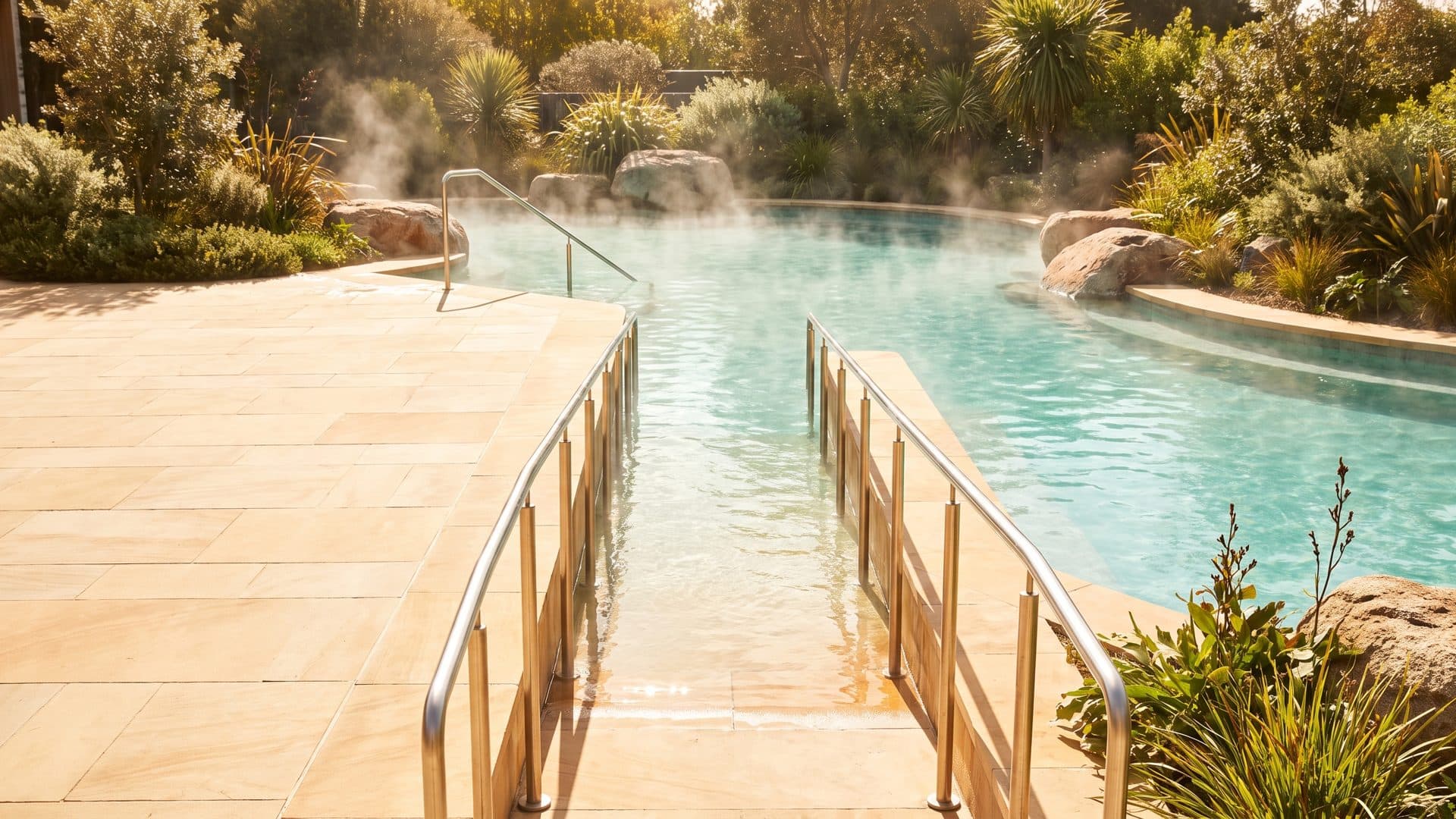
In 1883 three men working on the Canadian Pacific Railway, Frank McCabe and the brothers William and Tom McCardell, came across hot springs in the mountains above what is now the town of Banff. According to Wikipedia they fenced one off, built a rough cabin and ran it as a "hotel", hoping to own the water. The government had other ideas: in 1885 it reserved the land as the Hot Springs Reserve, and in 1887 the Rocky Mountains Park Act turned it into what is now Banff National Park. The bathhouse that stands at Banff Upper Hot Springs today opened in 1932, and Parks Canada runs it as a federal heritage building.
Heritage buildings were not made for wheelchairs, and Parks Canada is unusually frank about how this one copes. Reception is on the lower level, twenty stairs down from the entrance, with five more steps to the pool level; an elevator serves all three floors and a ramp through a side door replaces the last five steps. Some motorised chairs may not fit the elevator, and the page says so. The part that matters most is the wet hall. It slopes down into the hot pool, with handlebars on both sides at 876 millimetres, and the front desk lends an aquatic wheelchair on request, because personal wheelchairs are not allowed in the spring water. Parks Canada describes the aim as an accessible visit "within the limits of the heritage building", and then lists exactly where those limits are. Every operator should write like that.
Accessibility at a thermal bath is really several questions, and they come in order: the door, the changing room, the water, and the people on shift. 296 baths and water parks state that their entrance is step-free. That yes describes the way in and nothing beyond it, so the rest of this piece is about the other questions, as the operators who answer them describe their own buildings. 13 say plainly that there is no step-free way in, which is worth knowing too: an honest no saves a journey.
Does a step-free entrance mean you can get into the water?
Not by itself. A bath can have level paths, automatic doors and a lift between floors and still end in a flight of steps at the pool edge. The ways operators bridge that last metre vary a great deal, and they suit different people. Some use a mechanical lift beside the pool. Some have a sloped entry you can roll down in a water-safe chair. Some lend a chair designed to go into the water and leave the rest to you and your companion.
Water wheelchairs at the Blue Lagoon
The Blue Lagoon in Iceland is, by origin, a pool of run-off. Wikipedia explains that water from the Svartsengi geothermal power plant, opened in 1976, collected in the lava field next to it, and that bathing facilities followed in 1987. The milky blue colour comes from silica, which also settles as soft white mud on the bottom.
That bottom is the first thing the operator mentions in its accessibility notes. The lagoon is 1.4 metres at its deepest and shallower in most places, but the floor is naturally uneven, and an overview map of depths and temperatures stands by the lagoon entrance. You get into the water in specially designed wheelchairs that the lagoon provides; guests who arrive without a chair of their own can borrow one at reception or at the luggage building in the car park. The main complex has elevators and electric door openers. On the ground floor there is a changing room large enough to share with an assistant, and a shower chair on request. The operator also asks everyone to take care on floors around the lagoon, which may be slippery.
A lift in the bathing hall in Aachen
Aachen has been a bathing town for some two thousand years. The operator of the Carolus Thermen writes that the Romans built large baths over its hot springs and that Charlemagne, convinced of their healing effect, made the town a favoured palace in the late eighth century; the baths carry his name. The present building opened in February 2001, replacing the Quellenhof bath, and takes its water by pipeline from the Rosenquelle in the city centre, a sulphurous spring that the operator gives as 47 °C on average.
The operator's accessibility page is short and specific. Lifts connect the levels, there are two accessible changing rooms, and a lift in the bathing hall gives access to the large thermal pool. The building is accessible to people with walking difficulties "in almost all areas", which is the kind of qualifier worth noticing rather than skipping.
Two steps at the end of the ramp
Hepburn Springs, in central Victoria, has a story about who the water belongs to. In 1864, Wikipedia records, residents met at the Savoia Hotel and petitioned the government to protect the springs from gold mining, arguing the water was worth more than gold. The Hepburn Mineral Spring Reserve followed in 1865. Many of the town's settlers had come from Ticino, Grisons and northern Italy, and some from the spa towns of Germany and England. The bathhouse was built in the 1890s and has been remodelled several times, most recently in 2008.
Hepburn Bathhouse & Spa describes its access plainly. You reach the mineral bathing area from reception by an external ramp with handrails, to a side door that staff will point out. A lift runs between reception and the lower level, and there are accessible toilets and change rooms inside the bathhouse. Then comes the sentence that makes the page useful: the main pool ramp includes two steps at its lower end. The operator says this helps many guests but may make independent access harder for wheelchair users. The villas on the hillside are not accessible because of the terrain. A tick-box would never tell you that.
Is a new resort easier than an old bath house?
Often, and for an obvious reason. A building designed after accessibility became a requirement has it in the plan from the start, while a bath house from 1890 or 1932 has to fit lifts and ramps around walls that cannot move. That shows in the figures, if not dramatically: 35% of water parks state a step-free entrance, against 23% of thermal baths. Most water parks are recent buildings. Many thermal baths are not.
Peninsula Hot Springs on the Mornington Peninsula, south of Melbourne, is the new end of the range. Its founder, Charles Davidson, traces the idea to bathing at Kusatsu Onsen in the mountains of Japan in 1992; by 1997 he and his brother had set up the business on bushland at Fingal, and the first bathing area, the Spa Dreaming Centre, opened in 2005. Because the place was built from nothing, its accessibility page reads like a site plan. A ramp leads from the car park to Bath House reception. After check-in, an accessible lift takes you to the family change rooms and the bathing areas, and graded paths run through the Bath House. The Watsu pool in the Bath House is listed as wheelchair accessible. Most of the other pools, from the cave pool to the hamam, are described as suited to moderate mobility needs, with handrails on all steps. Reception lends an aqua wheelchair designed for geothermal water, free of charge.
Age is not the whole story, though. Banff's 1932 bathhouse has a sloped entry into the hot pool that many modern pools lack, and Hepburn's 2008 remodel still left two steps at the bottom of the ramp. What decides your day is the specific arrangement at the specific pool, and that is only ever on the operator's own page or at the end of a phone line.
Where the lockers are
Small details carry weight here. At Banff the two accessible change rooms are separate from the men's and women's rooms, and each has a handheld shower, a shower seat, a chair and an emergency pull cord. Your clothes, though, go into lockers outside the room, and they are stacked two high, so Parks Canada asks visitors who can reach the upper row to use it and leave the lower ones free. It is a small courtesy that makes a big difference to someone else.
What should you ask a thermal bath before you travel?
Everyone's needs are different, and many people need none of this. If you do, these are the questions the operators above answer on their own pages, which makes them reasonable to ask anywhere else.
- How do people get into the water? Ask about the pool, not the building: a lift, a sloped entry, a water wheelchair, steps with a handrail. If there is a lift, ask which pool it serves and who operates it. Carolus names its large thermal pool; Peninsula names its Watsu pool.
- Can my own chair go in, or do I transfer? At Banff personal wheelchairs are not allowed in the spring water and the bath lends its own. At the Blue Lagoon the lagoon's own chairs are the way in. Knowing this in advance tells you whether a transfer is part of the visit.
- Where is the accessible changing room, and is it on the wet side? A changing room in the foyer is no help once you are in a swimsuit. Ask whether it is big enough for a helper, as the Blue Lagoon's is, and whether there is a shower seat.
- What is the floor like? Depth, slope, uneven natural bottoms and slippery tiles are all things the Blue Lagoon mentions unprompted. Elsewhere you may have to ask.
Ask by email if you can, so you have the answer in writing, and ask again a few days before you go. Lifts are serviced, staff change, and equipment that is on the website may be out for repair the week you visit.
What does warm water do, and what should you check first?
Warm water does two things by nature. Buoyancy takes much of the body's weight, so moving in water can feel easier than moving on land, and warmth is pleasant on stiff muscles. Neither is a promise of treatment. Thermal water is also hot water, and long sessions in it are tiring in ways that are easy to underestimate when you are floating comfortably.
If you have a heart or circulation condition, problems regulating temperature, or a condition that affects sensation in your skin, ask your doctor before bathing in hot water, and ask the bath about the temperature of each pool. Anything a bath says about healing is the operator's statement, not medical advice. For what thermal water can and cannot do for joints and backs, see our piece on thermal water and joint pain.
The list under this article holds the 296 baths and water parks that state a step-free entrance, from the 1932 bathhouse in Banff to the lagoon in the Icelandic lava field. Treat each one as a reason to write to the operator, and start with the question about the water.