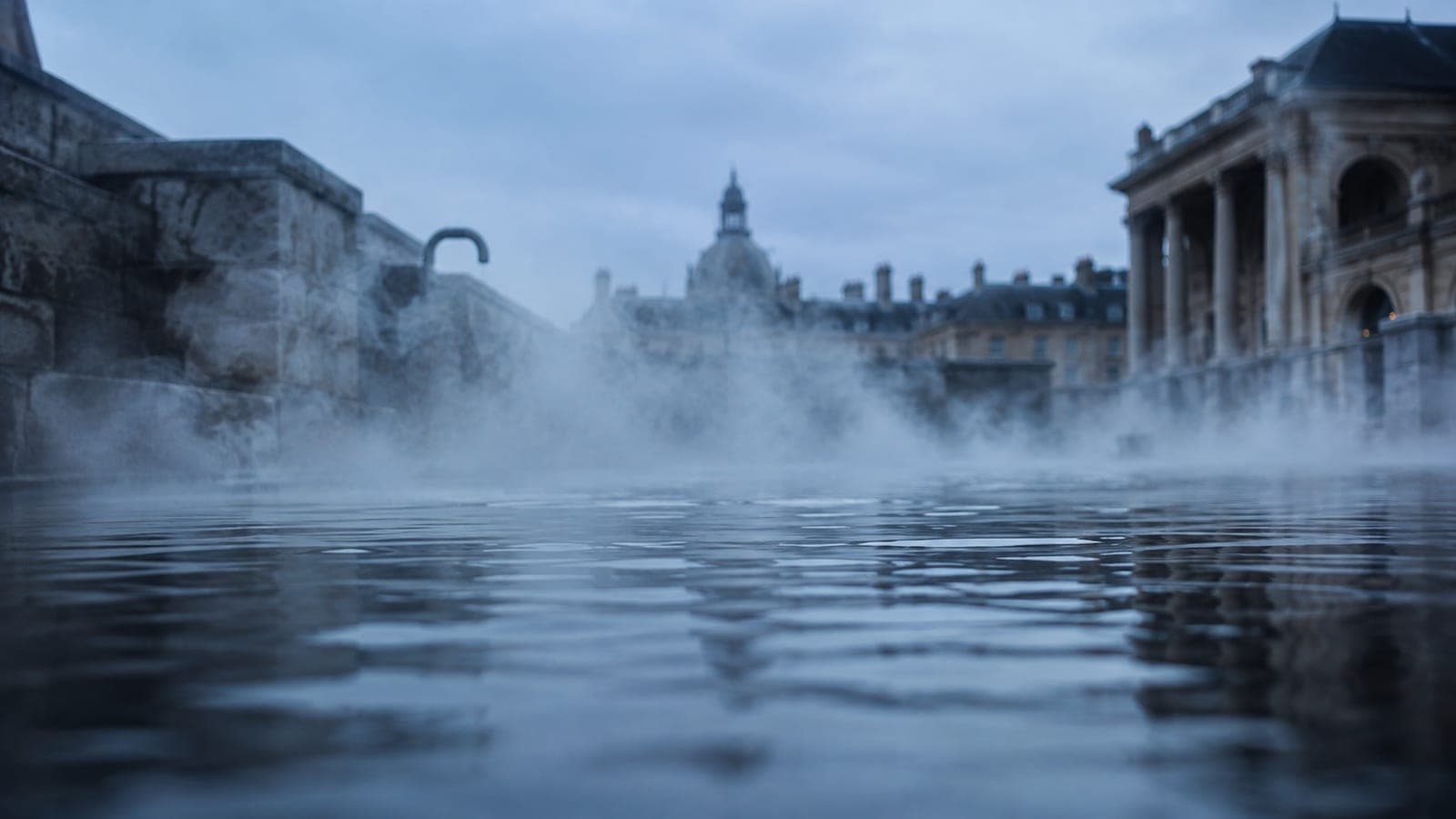
In 1894 Ľudovít Winter, the man who built up the spa at Piešťany in western Slovakia, asked the painter Arthur Heyer for a symbol of recovery that needed only one figure. Heyer drew a man breaking his crutch over his knee. According to the town's information centre, the barlolámač, the crutch-breaker, has been the emblem of the spa and the town ever since, and about forty years later the sculptor Robert Kühmayer cast it in bronze. It stands at the end of the colonnade bridge that Emil Belluš designed in the early 1930s, at the way onto Spa Island.
The image says what every spa brochure for bad backs says, only more bluntly. What lies behind it at Slovenské liečebné kúpele Piešťany, the spa on the island, is specific. Water rises from the ground at 67–69 °C. Mud is taken from a side arm of the river Váh, and Wikipedia records that it is used in pools at about 39 °C. The operator calls the mud one of the most recognised natural peloids in the world and states that it is "used primarily for the treatment of musculoskeletal disorders."
Piešťany is not alone in saying so. 160 thermal baths state that their water is used for musculoskeletal complaints, the medical term that covers joints, back and muscles, and 84 of them name rheumatic complaints as well. Here is who is saying it, and what the people who study the evidence have concluded.
Does thermal water actually help joint pain?
It has been studied, and the studies are not strong. The most careful summaries come from Cochrane, the international network that pools clinical trials into systematic reviews.
Its review of balneotherapy for osteoarthritis, published in 2007, looked at seven trials with 498 patients who had osteoarthritis of the knee, hip or lower back. Balneotherapy here means bathing in mineral or thermal water, sometimes with mud. Their plain-language summary says that time in a mineral bath, compared with no treatment, may improve pain and quality of life. In their conclusions the authors call the scientific evidence weak because of the poor methodological quality of the trials, and say the positive findings should be viewed with caution. Side effects were not measured.
The review for rheumatoid arthritis, updated in 2015, covered nine studies with 579 participants. Its conclusion is plainer: the overall evidence is insufficient to show that balneotherapy is more effective than no treatment, or that one type of bath works better than another, or better than mudpacks, exercise or relaxation. Most of the evidence was rated low or very low in quality.
None of this means a warm bath does nothing. It means that when a spa says its water "helps" your joints, that is the spa's statement, and the trials that have tested such statements have mostly been small and hard to interpret. Your own doctor, who knows what kind of arthritis you have and what else you are dealing with, is the person to weigh it.
What is the difference between medicinal water and a slogan?
Some countries regulate the words. In Hungary a water may be called gyógyvíz, medicinal water, only with permission from the national authority; Hungarian law defines it as a natural mineral water with a proven healing effect, a stable chemical character and no harmful substances. In Germany Heilwasser is regulated as a medicinal product and needs an official licence, with an exception for water used on site for bathing or inhalation. "Healing", "therapeutic" and "wellness" are not protected terms in either country. 96 of the 160 baths that make the musculoskeletal claim hold an official medicinal-water certification of this kind.
A borehole that found the wrong thing
The water at Mezőkövesd was found by people looking for something else. In 1938 Lajos Zsóry, a landowner in this town in the north-east of Hungary, allowed an exploratory borehole for oil on his land and paid for the pipes. There was no oil. On 25 February 1939, according to Hungarian Wikipedia, a column of hot water about 30 metres high burst out of the well, like a geyser, from a reservoir at 875 metres. The Ministry of Health declared the wells medicinal water in 1968, and in 1983 the bath was given the status of a medicinal spa of national importance. It still carries his name: Zsóry Gyógy- és Strandfürdő.
The water is a sulphurous one, and the same article describes its sulphide content as the highest among Hungary's sulphur waters. You will notice it before you see the pool. Hydrogen sulphide smells of eggs, and the nose picks it up at concentrations far too small to matter chemically. The bath also supplies the treatment water for the county rheumatology hospital built 400 metres away in 1986: part of a medical service, not only a day out.
A lake that changes its water every few days
At Hévízi Tófürdő, near the western end of Lake Balaton, you bathe in a lake rather than a pool. The operator describes it as 4.4 hectares in size, fed from a spring cave about 38 metres down, with a bed of peat several metres thick from which medicinal mud forms. It states that the water is completely replaced every third day. The healing reputation of the lake is old: Wikipedia notes that it was first mentioned in writing by the scholar Matthias Bel in 1731, and that the Festetics family, the local landowners, began scientific research into its use in the eighteenth century.
The operator lists degenerative diseases of the spine and joints and chronic inflammatory joint diseases among the conditions it treats. Its guidance on bathing is just as specific. It recommends 20–30 minutes in the water at a time and no more than an hour to an hour and a half a day in total. Its house rules say bathing in the lake is not advised for certain heart conditions, for high blood pressure, for anyone with a fever or an infectious disease, or during pregnancy, that it is not recommended for children under twelve, and they ask every visitor to consult a doctor before bathing in the lake. Swim rings can be rented on site.
How warm should the water be for stiff joints?
Warm, but not as hot as the spring. Arthritis UK, the British charity formerly called Versus Arthritis, describes aquatic therapy, the physiotherapist-led exercise for arthritis in a warm pool, as taking place in water usually at 33–36 °C, warmer than a typical swimming pool. Worcestershire Acute Hospitals NHS Trust heats its hydrotherapy pool to 34.5 °C. These are hospital pools of ordinary heated water, not mineral springs, and the charity describes slow, controlled movement and relaxation, not aqua aerobics. It says it is normal to feel tired afterwards, and warns that because the water supports you, you may feel able to do more than usual. The NHS trust adds a simple instruction: drink after your session to prevent dehydration.
Thermal baths publish their own numbers. Of the 160 baths that make the musculoskeletal claim, 93 publish a pool temperature. 42 of those run between 34 and 36 °C, close to the range Arthritis UK gives for therapy pools. 37 run at 37 °C or warmer, body temperature and above.
The spring and the pool are rarely the same thing. In 1831, according to the operator of Les Bains de Lavey, a fisherman on the bank of the Rhône in the canton of Vaud came across hot water by chance; a geologist later confirmed the spring. Today it is drawn from 600 metres down, and the operator describes it as the hottest thermal water in Switzerland. The pools, indoors and outdoors, are kept at 33–36 °C. The operator says the water does the body good, "notably for the joints and the skin", and that is its claim to make.
Spa treatment or a day at the baths: which is it?
The same water can be offered in two quite different ways.
The first is treatment. Lázně Teplice v Čechách, in northern Bohemia, describes itself as the oldest spa in Central Europe, with two thousand years of bathing history. In the eighteenth and nineteenth centuries the town drew emperors and composers. Wikipedia records that Beethoven met Goethe there in 1812 and began his Seventh Symphony the same year. What the operator offers adults today is far less romantic and more useful to know about: intensive programmes mainly after hip or knee replacement, along with pain management. For children it lists programmes for juvenile chronic arthritis, scoliosis and cerebral palsy. That is rehabilitation with a medical team, and the thermal water is one tool among several.
In France this kind of stay has a formal shape. The Assurance Maladie, the national health insurer, covers a cure thermale only when a doctor prescribes it for one of twelve approved therapeutic orientations, rheumatology among them, at an approved establishment, for 18 days of actual treatment, and only after you have applied to your health insurance fund in advance. The rule is one cure per condition per calendar year.
The second is bathing for its own sake, and some of the old houses do it in grand style. The Friedrichsbad in Baden-Baden was built between 1869 and 1877 to designs by Karl Dernfeld. The operator says it opened as the most modern bath house in Europe. Its water comes from twelve springs, according to Wikipedia, at up to 68.8 °C. The Roman-Irish ritual runs through more than a dozen stations: thermal showers, a warm-air room at 54 °C, a hot-air room at 68 °C, a soap-brush massage, steam baths, pools, a cold plunge, then a room to rest in. The operator recommends allowing about three hours. Most days are textile-free and mixed; our piece on textile-free bathing explains how that works. Wikipedia reports a line often attributed to Mark Twain, that after ten minutes you forget time and after twenty the world, and notes that the attribution is uncertain.
They are different days. A course of treatment is prescribed and supervised; a ritual like the Friedrichsbad's is chosen, and the question there is whether you are fit for heat, steam and a cold plunge.
What should you ask before you book?
Start with your doctor, and bring the operator's own rules. Hévíz lists heart conditions, high blood pressure, fever, infection and pregnancy as reasons not to bathe in its lake. Arthritis UK tells people to mention heart problems, breathing difficulties, kidney disease, infections and conditions that are not well controlled, such as diabetes or epilepsy, to the physiotherapist before warm-water therapy.
Then read the spa's own page with three questions in mind.
Is the claim in a regulated word? Gyógyvíz and Heilwasser mean an authority has looked at the water. For what those terms involve country by country, see our guide to certified medicinal water, and for the difference between thermal, mineral and medicinal, this explainer.
What is the pool temperature, as opposed to the spring? Lavey's spring and Lavey's pools are about thirty degrees apart, and only one of them is where you sit. Some operators also post a limit on time in the water, as Hévíz does, and that limit is part of the guidance, not small print.
Is this treatment or bathing? If the page talks about prescriptions, a medical examination on arrival or a doctor on site, it is a spa in the medical sense; in France such a stay begins with a doctor's prescription. If it talks about rituals and rest rooms, enjoy it as that.
If the smell at Mezőkövesd made you curious, our piece on sulphur water explains it; radon water has its own explainer.
The crutch-breaker on the bridge at Piešťany is a promise drawn in 1894, and the spas are entitled to make it. Whether it is a promise for you is a question for someone who has examined you.