In 1660 Sigismondo Ercole Thun wrote in a letter that he meant to go to Rabbi, a side valley in Trentino, "to drink the salty water, as the doctor has advised me". That letter is the oldest reference the operator of Terme di Rabbi has found to anyone taking the cure there. The spa stands at Fonti di Rabbi today, and its operator describes the water much as the eighteenth century did: acidulous and ferruginous, rich in carbon dioxide and magnesium.
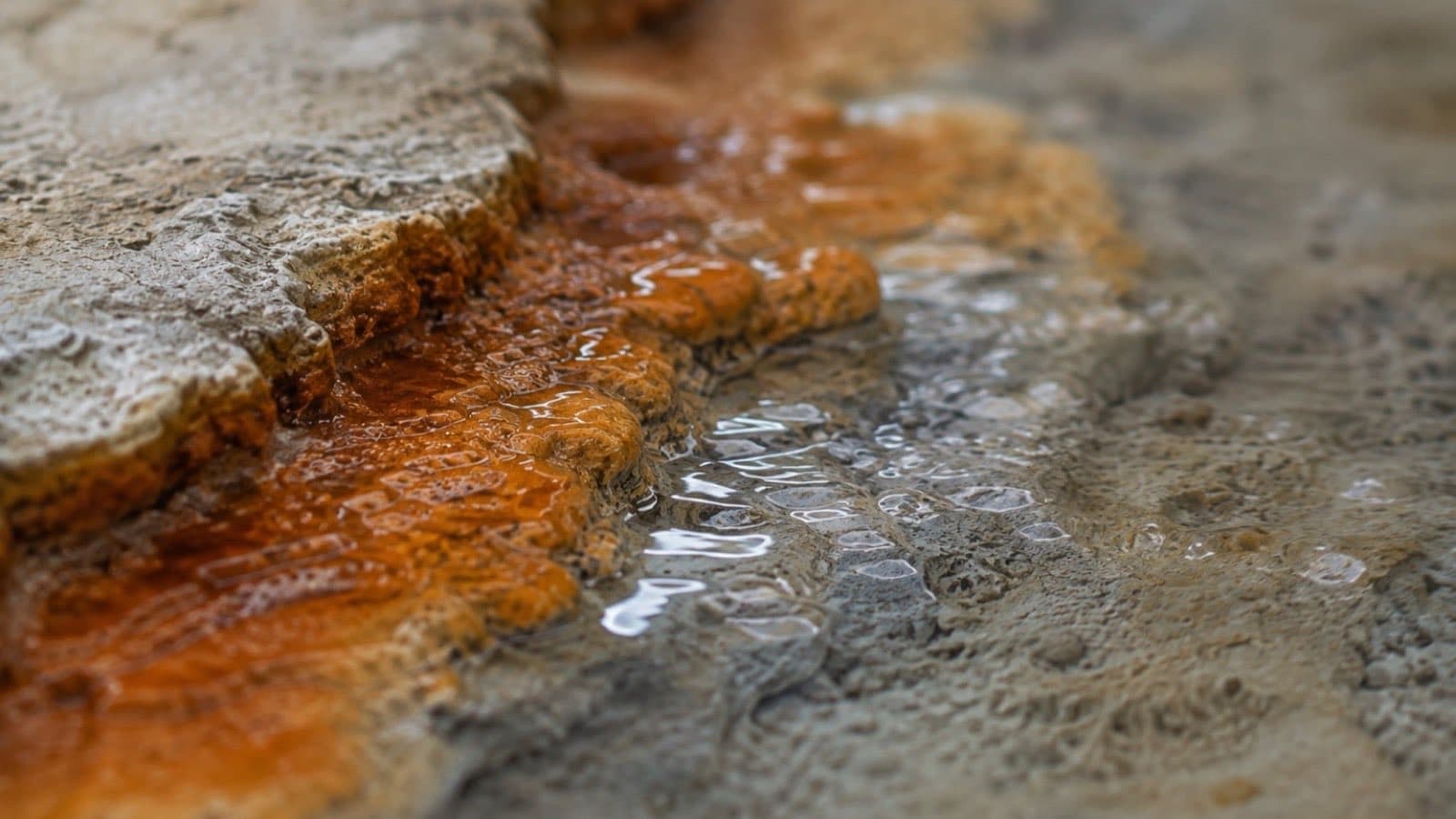
What Thun would have seen at the spring is what you see at every iron spring today. The water runs clear. The stone it runs over does not. A small piece of chemistry explains the difference, and most of what is distinctive about these baths.
Why is the stone orange when the pool is clear?
Because the iron only turns orange once it meets oxygen. Deep groundwater has very little oxygen in it and is usually slightly acidic, and under those conditions iron stays dissolved as iron(II), the ferrous form. It has no colour.
At the surface the water picks up oxygen, and iron(II) is oxidised to iron(III). Iron(III) does not stay in solution. It drops out as a fine iron hydroxide, the rust-coloured precipitate that engineers filter out of well water, and settles on whatever the water touches. A channel or a wall with water running over it all day collects it layer by layer. A pool that is filtered and cleaned stays clear.
So the orange is a record of contact with the air, not a measure of how much iron is in a litre. A trickle down a wall can look spectacular while a bath with plenty of iron in its analysis shows you almost nothing in the main pool.
Carbon dioxide is part of the story. Many old iron springs are naturally carbonated, and dissolved CO₂ makes water more acidic, which helps keep the iron in solution. That is why the historical name for so many of them combines the two: acidula ferruginosa, the acidulous iron water. It also explains a pattern in the analyses: hydrogencarbonate, the form most of that dissolved carbon dioxide ends up in, is named alongside iron at 6 of the 21 baths whose operators list iron.
Chalybeate: the old word
English has its own term for these waters. They were called chalybeate, from the Latin chalybs, steel, itself named after the Chalybes, an ancient people known for working iron. The best-known English example is the spring at Tunbridge Wells, which Dudley North, 3rd Baron North, is credited with discovering in 1606. In the early seventeenth century these waters were promoted as healthful, and one physician claimed they could treat colic and melancholy.
Can you drink iron thermal water?
At several of these places, drinking was the point from the start. Iron springs were classic drinking-cure springs, and some of them still run their cure the old way, with a doctor deciding what you drink and how much.
Rabbi: from a count's letter to a water analysis
The operator of Terme di Rabbi has put together the history of its spring from documents, and it reads like a list of the people who mattered to the place. In 1777 the physician and naturalist Johann Heinrich Nepomuk von Crantz included Rabbi in his survey of the healing springs of the Habsburg monarchy, dedicated to Maria Theresa, and classified the water as an acidulous iron water. In 1795 the Archduchess Maria Elisabeth of Austria, abbess of the noble ladies' chapter in Innsbruck, stayed at Cles in the neighbouring Val di Non. The diarist Giangrisostomo Tovazzi noted the preparations for a visitor who "wants to come and drink the acidulae", and the historian Jacopo Antonio de Maffei recorded that the crowd of every class of people was something unusual in those valleys.
The scientific turn came in 1912 and 1913, when Josef Zehenter published a detailed analysis of the old spring. There is also a story of a young shepherd who noticed how well his sheep did on the water; the operator says plainly that it is oral tradition, not attested by any source of the time.
Today the operator lists drinking cures alongside inhalations and baths, and a guided thermal route of about two hours through three grades of heat, from the most humid to the driest.
Bardejov: ten springs and an empress
At Bardejovské kúpele, in north-eastern Slovakia, the first written mention of the mineral springs goes back to 1247, in the reign of the Hungarian king Béla IV, and regular treatment began in the fifteenth century, according to the Slovak tourist board. Marie Louise, the wife of Napoleon, came here, and so did Tsar Alexander I. The spa itself tells the story of its most famous guest: Empress Elisabeth, Sisi, stayed in 1895 to treat her health, and the spa keeps a museum apartment in her name in the house called Alžbeta.
The operator describes ten springs rising in a small area within the spa grounds, and classifies the water as bicarbonate-chloride and sodium, ferric and carbonated, with an elevated content of boric acid. Klára is described as ferrous and carbonated with traces of hydrogen sulphide. The one named Napoleon is ferrous too. The Kolonádny spring, the operator states, is suited to the treatment of anaemia, which is the oldest association iron water has. The doses, the spa says, are set by a doctor according to the indication and the client's condition.
Radenci: a medical student hears bubbling
The story of Zdravilišče Radenci in north-eastern Slovenia starts with a sound. According to Wikipedia, local people believed the bubbling from the ground was witches cooking soup underground. In 1833 Karol F. Henn, then still a medical student, heard it from a passing carriage, took samples, and came back in 1869 as a doctor and balneologist to buy the land with the spring. The same year the first water was bottled, and the "Three Hearts" mineral water that came out of it was later supplied to the imperial court in Vienna and to the papal palace in Rome. The first spa guests arrived in 1882.
The resort, now run by Sava, still uses the carbonated water in baths, inhalations and drinking treatments, and offers what it calls the Henn drinking treatment: several glasses a day from the oldest spring in Radenci.
How warm is iron thermal water?
Iron is not tied to any particular temperature. Some of the classic iron springs are cold, used for drinking and heated for bathing. Others come out of the ground warm. At the baths that publish the figure, the pool usually sits close to body temperature: 7 of the 11 baths with a stated pool temperature keep the water between 34 °C and 38 °C. Wells reaching 1,000 m or deeper supply 3 of these baths.
Pré-Saint-Didier: warm water at the foot of Mont Blanc
In the Aosta Valley the water arrives warm on its own. The Italian tourist board describes the springs of Pré-Saint-Didier emerging at 37 °C in a grotto at the base of the Orrido, the gorge the Dora di Verney has cut through the rock just above its confluence with the Dora Baltea. The springs were known to the Romans, but, according to Italian Wikipedia, their use as a spa only began in the middle of the seventeenth century. The historic thermal building dates from 1834, under the Kingdom of Sardinia; the village was called Pré-Saint-Didier-les-Bains because of it, and for more than 150 years the baths were frequented by members of the House of Savoy. They reopened in the 2000s, and today the place is QC Terme Pré Saint Didier.
Scuol: the spring behind a locked tunnel
In the Lower Engadine, the Graubünden tourist board counts more than twenty mineral springs in the municipality of Scuol, a variety it puts down to the unusual geology of the Lower Engadine Window. Mineral water runs continuously from five of the village fountains, and the water has shaped the place since it was first mentioned around 1369.
The iron spring among them is the Vi spring. A tunnel about 30 metres long, not open to the public, leads to it. Its main constituents, as the tourist board lists them, are calcium at 384 mg/l, magnesium at 24 mg/l, hydrogencarbonate at 1,280 mg/l and ferrous iron at 8 mg/l. From there the water is piped to Bogn Engiadina, the bath that revived Scuol's spa tradition in 1993 and that, according to Wikipedia, included the first Roman-Irish bath in Switzerland.
If you want to taste the water before you bathe in it, the tourist board's fountain route through Scuol is about 3 km and takes around an hour, and it suggests bringing a cup or a glass bottle. The Vi spring is the only spring on the route itself; everything else you drink along the way comes from the village fountains.
What to expect at an iron bath
Most of the 21 baths that name iron among the dominant constituents of their water look like any other thermal bath. 8 of them hold an official medicinal-water certification, a status granted by an authority after testing rather than chosen by a marketing department. The differences show at the edges.
- Look at the water's path, not the pool. Inlets, overflow channels and drinking fountains carry the staining. The main pool is filtered and will tell you little.
- Drink at the source, from glass. The water is closest to how it left the ground where it comes out of the pipe. Once poured and left to stand, it loses some of its iron to the air and the bottom of the glass.
- Think about pale swimwear. Iron hydroxide is the same material that leaves rust marks on laundry washed in iron-rich well water. A white costume that spends a week at the fountain may not come back white.
- Ask when the analysis was done. Composition changes slowly, but the sheet on the wall can be decades old and a well may have been redrilled since. It is fair to ask for the current one.
A drinking cure or a day in the water?
These are two different visits. A drinking cure, as Bardejov and Rabbi describe it, is a medical programme with a doctor setting doses over days. A day at a warm iron bath like Pré-Saint-Didier or Bogn Engiadina is a bath like any other, with the iron mostly visible on the stone. For the cure, look for a spa that states its indications and its medical supervision; for the water and the mountains, choose the warm springs.
Does bathing in iron water help?
The claims on operators' pages are theirs, and they vary. Terme di Rabbi lists circulatory, respiratory and joint uses for its water; Bardejov states that one of its springs is suited to anaemia and sets out uses spring by spring; Radenci offers its drinking treatment. These are statements by the operators and the medical services they employ, not findings this article can confirm, and drinking cures in particular are prescribed and dosed by doctors on site for a reason. If you have a condition you hope to treat, or you take medication, ask your doctor before you book a cure or drink iron water by the glass.
The article on sulphur thermal water covers the one you smell before you see. The list under this article gathers the baths whose operators name iron in their water, from the Engadine fountains to the Slovenian spas around Radenci and the colonnade at Bardejov; the certified ones are the places to start if a drinking cure is what you have in mind.